
Home patient care skills – Proper, safe, and responsible care.
Home care for the sick. It is a job that requires a great deal of care, patience, and understanding. Patients may be weak, in pain, tired, have difficulty walking, have poor appetite, be bedridden for extended periods, be recovering from surgery or a stroke, or require assistance with most daily activities.
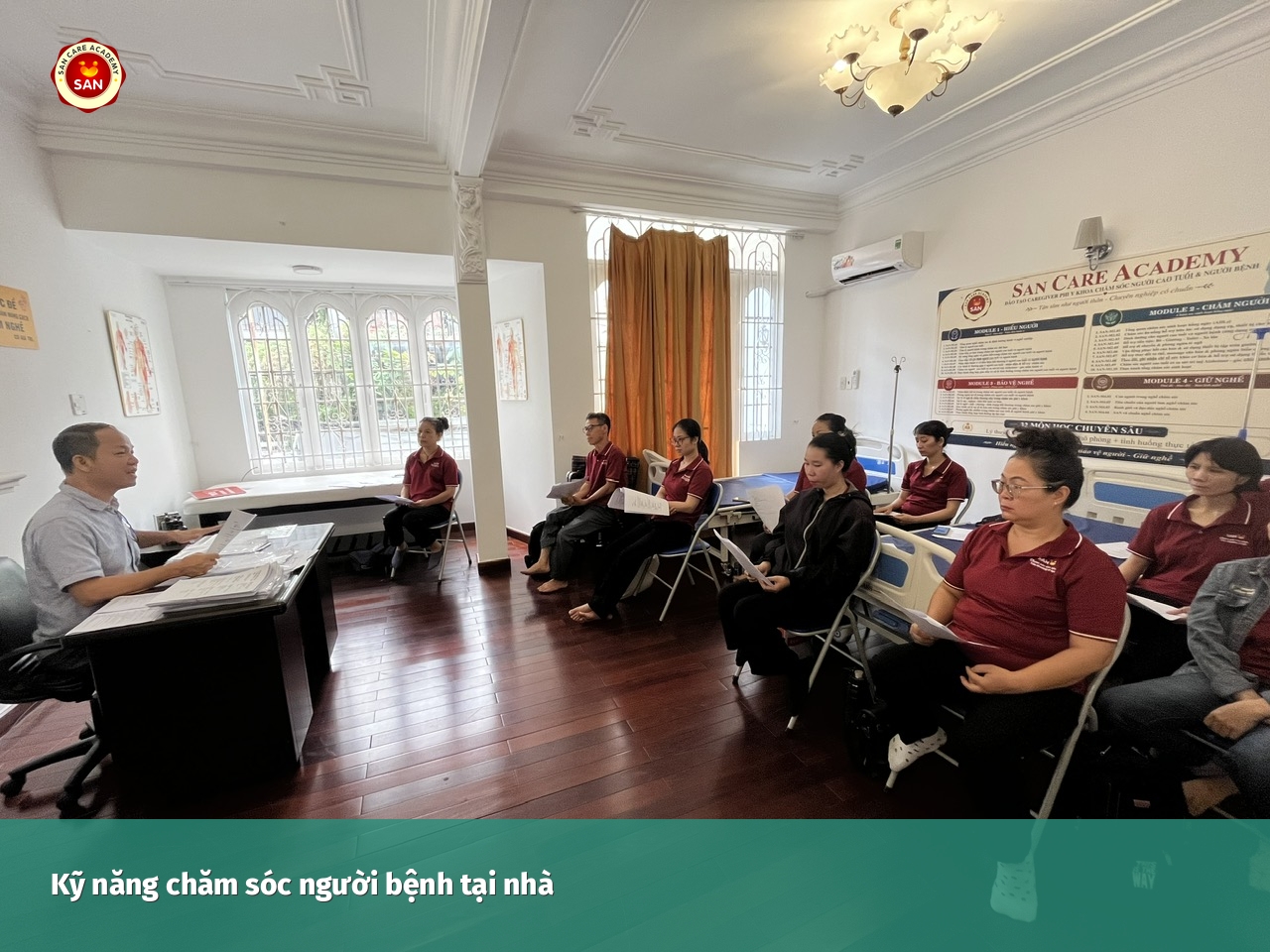
If caregivers lack the necessary skills, even small tasks can become risky. Incorrect feeding techniques can cause patients to choke. Helping a patient stand up too quickly can cause them to fall. Failure to adjust their position properly can increase the risk of pressure ulcers. Poor hygiene practices can cause patients embarrassment and loss of self-esteem.
Therefore, home care skills are not just about knowing how to do manual labor. They involve the ability to provide proper care, observe correctly, report accurately, and understand the limitations of a non-medical caregiver.
SAN Care Academy provides training in patient care skills that are practical, safe, respectful, and responsible.
Why is it necessary to learn home care skills for the sick?
Many families think that caring for a sick person at home simply involves feeding, changing clothes, hygiene, reminding them to take medication as directed, and sitting beside them. But in reality, each task requires skill.
Patients may be weaker than the average person, react more slowly, be more sensitive to pain, and be more emotionally vulnerable. A hasty action can cause them pain. An insensitive remark can upset them. Forgetting to report an unusual symptom can delay the family's awareness of the situation.
Caregivers don't need to replace doctors or nurses. But caregivers need to know how to do their part correctly in the non-medical field: assisting with daily activities, maintaining hygiene, preventing risks, observing, and reporting.
Learning patient care skills makes caring for patients safer, clearer for families, and more professional for caregivers.
What skills are involved in patient care?
Home care skills encompass a wide range of abilities, from assisting with daily living activities to observation, reporting, and communication.
Support for safe eating
Patients may eat slowly, eat little, have difficulty swallowing, cough easily, choke easily, or become tired while eating. Caregivers need to know how to prepare the right posture, provide gradual support, observe for any unusual signs, and avoid forcing the patient to eat too quickly.
If the patient frequently coughs while eating, has difficulty swallowing, eats poorly, or is excessively tired, the caregiver should notify family members or the appropriate healthcare professional.
Caregivers should not change the diet, administer medication, supplements, or special foods without guidance from family members or healthcare professionals.
Personal hygiene support
Patients at home may need assistance with wiping, bathing, changing clothes, changing diapers, cleaning after bowel movements or urination, changing sheets, and keeping their bodies clean.
This is a very sensitive skill set. Patients may feel embarrassed to ask others for help with even the most private tasks. Therefore, caregivers need to give advance notice, maintain discretion, act gently, and avoid saying anything that would embarrass the patient.
Proper hygiene not only helps patients stay cleaner, but also makes them feel more comfortable and respected.
Support for changing posture
Patients who are weak, bedridden, or recovering from surgery or a stroke may need assistance with turning over, sitting up, lying on their side, or changing positions.
If done incorrectly, the patient may experience pain, dizziness, fear, or a jerking sensation that causes discomfort. Caregivers need to proceed slowly, give advance notice, and observe the patient's reactions.
Proper positioning assistance helps patients feel more comfortable and contributes to reducing the risk of pressure ulcers in those who are bedridden for extended periods.
Caring for bedridden patients
Bedridden patients require more careful attention to hygiene, feeding, changing clothes, diapers, sheets, turning over, skin monitoring, and maintaining a clean environment around the bed.
Caregivers need to understand that bedridden patients are prone to sadness, self-pity, and a loss of control. Therefore, every caregiving action should be gentle and respectful.
Caring for a bedridden patient requires more than just good health. Caregivers need skill, patience, and a very careful attitude.
Pressure ulcer prevention
Pressure ulcers are a common risk in patients who are bedridden or have limited mobility.
Caregivers should monitor pressure points, keep the skin clean and dry, assist with proper positioning, and notify family if they notice redness, pain, heat, moisture, discoloration, or any other unusual signs.
Non-medical caregivers should not attempt to treat ulcers or complicated wounds without proper expertise and guidance. Early detection and reporting to the right person are crucial.
Fall prevention
Patients who are weak, dizzy, recovering from surgery, stroke, or taking prescribed medication may be more prone to falls when standing up, using the toilet, or moving around the house.
Caregivers need to check the environment: is the floor slippery? Are there any obstructions in the walkways? Are the slippers secure? Is the lighting adequate? Is the toilet safe?
When assisting a patient to stand or walk, avoid pulling forcefully or rushing. Give advance notice, take small steps, and stop if the patient is tired, in pain, dizzy, or shows any unusual symptoms.
Observe for any unusual signs.
Non-medical caregivers should not self-diagnose illnesses, but should be able to observe unusual changes.
Signs to watch out for may include fever, shortness of breath, increased coughing, worsening pain, poor appetite, increased fatigue, dizziness, falls, changes in consciousness, abnormal urination or defecation, redness of the skin, unusual wounds, or a noticeable change in mood.
When noticing any unusual signs, caregivers should promptly inform the family or supervisor. They should not self-medicate, change medications, or handle situations beyond the scope of their care.
Communicating with patients and their families.
Patients may experience pain, fatigue, anxiety, irritability, or sadness due to their dependence. Caregivers need to communicate gently, clearly, and give advance notice before providing assistance, ensuring the patient does not feel disrespected.
For family members, caregivers need to report truthfully, concisely, and promptly. The family needs to know how the patient ate and slept that day, whether they experienced any pain or fatigue, if there were any unusual symptoms, and what support the caregiver provided.
Good communication helps reduce misunderstandings, increase trust, and make caregiving safer.
Limitations of non-medical caregivers
One of the most important aspects of learning patient care is understanding the limitations of a non-medical caregiver.
Caregivers can assist with daily activities, eating, hygiene, changing positions, mobility, observation, and reporting. However, caregivers should not prescribe medication, change medications, administer injections or infusions, treat complex wounds, perform medical interventions, or make diagnoses without proper expertise and authorization.
Knowing your limits is part of professionalism. A good caregiver isn't someone who does everything, but someone who knows how to do their job properly, knows when to report problems, and knows how to protect the patient from unnecessary risks.
Common mistakes when caring for patients at home.
Some common mistakes include feeding the patient too quickly, helping the patient stand up too hastily, inadequate hygiene, failing to observe the skin, leaving the patient in one position for too long, not reporting any unusual symptoms, self-medicating, or attempting to treat problems beyond the scope of the treatment plan.
Many mistakes don't stem from bad intentions, but rather from a lack of skill or understanding of safe care practices.
Therefore, caregivers need to be properly trained before caring for patients, especially those who are frail, bedridden for extended periods, recovering from surgery, recovering from strokes, or requiring significant assistance with daily activities.
How does SAN Care Academy train patient care skills?
SAN Care Academy Training in patient care skills that are practical, safe, and within the scope of non-medical care.
Trainees learn how to assist with eating, hygiene, dressing, diapering, changing positions, caring for bedridden patients, preventing pressure ulcers, preventing falls, observing for abnormal signs, communicating with and reporting to family members.
SAN Care Academy does not train students to replace healthcare professionals. SAN trains caregivers to provide proper support for daily living, to observe, to report, and to maintain the dignity of patients.
For suitable students, after the initial foundational learning phase, SAN can guide them towards supervised internships to familiarize them with a real caregiving environment.
These satellite lessons belong to the Patient Care Skills pillar.
To gain a deeper understanding of home care skills, you can read more articles on the same topic:
- VT 01: What skills are needed for home care for patients?
This article summarizes the fundamental skills that caregivers need when supporting patients at home. - VT 02: How to care for a bedridden patient
This article delves into the care of bedridden patients, including hygiene, diaper changes, linen changes, turning patients, preventing bedsores, and monitoring for abnormal signs. - VT 03: How to prevent pressure ulcers in bedridden patients
This article helps caregivers understand the principles of ulcer prevention, how to observe the affected skin area, and how to inform family members if any abnormalities are detected. - VT 04: How to support patients at home after surgery
This article focuses on non-medical support for daily living, hygiene, eating, mobility, and post-operative observation. - VT 05: How to care for patients after a stroke
This article provides guidance on important considerations when caring for patients after a stroke, including eating, movement, communication, preventing choking, preventing falls, and preventing bedsores. - VT 06: How to monitor for abnormal signs when caring for a sick person
This article helps caregivers observe eating, sleeping, pain, fatigue, breathing, skin, bowel and bladder function, mood, and report any issues promptly. - VT 07: What can and shouldn't non-medical caregivers do?
This article clarifies the scope of work for non-medical caregivers, preventing unauthorized medical interventions beyond their expertise. - VT 08: When should I notify family or healthcare professionals?
This article provides guidance on situations that require immediate attention when caring for a sick person at home.
Who should learn patient care skills?
This content is suitable for those who want to learn the profession of patient care, beginners, current caregivers, and those who have previously cared for patients but have not received formal training. domestic worker They want to switch to more professional patient care, and their children and grandchildren are caring for their relatives at home.
This is also essential content for families with patients who have undergone surgery, suffered a stroke, are bedridden for extended periods, are very weak, or require assistance with daily activities.
Register for a consultation on home patient care courses.
If you wish to learn proper, safe, and career-oriented home patient care skills, SAN Care Academy can recommend a suitable course.
You can register to receive a consultation:
- The home patient care course is suitable.
- Skills in eating, hygiene, changing posture, and walking.
- Skills in caring for bedridden patients
- Skills in preventing bedsores, preventing falls, and observing abnormal signs.
- Latest tuition fees and class schedules
- Supervised internship conditions
- Career guidance after the course
Sign up for a consultation today to learn how to provide proper, safe, and responsible patient care.


