
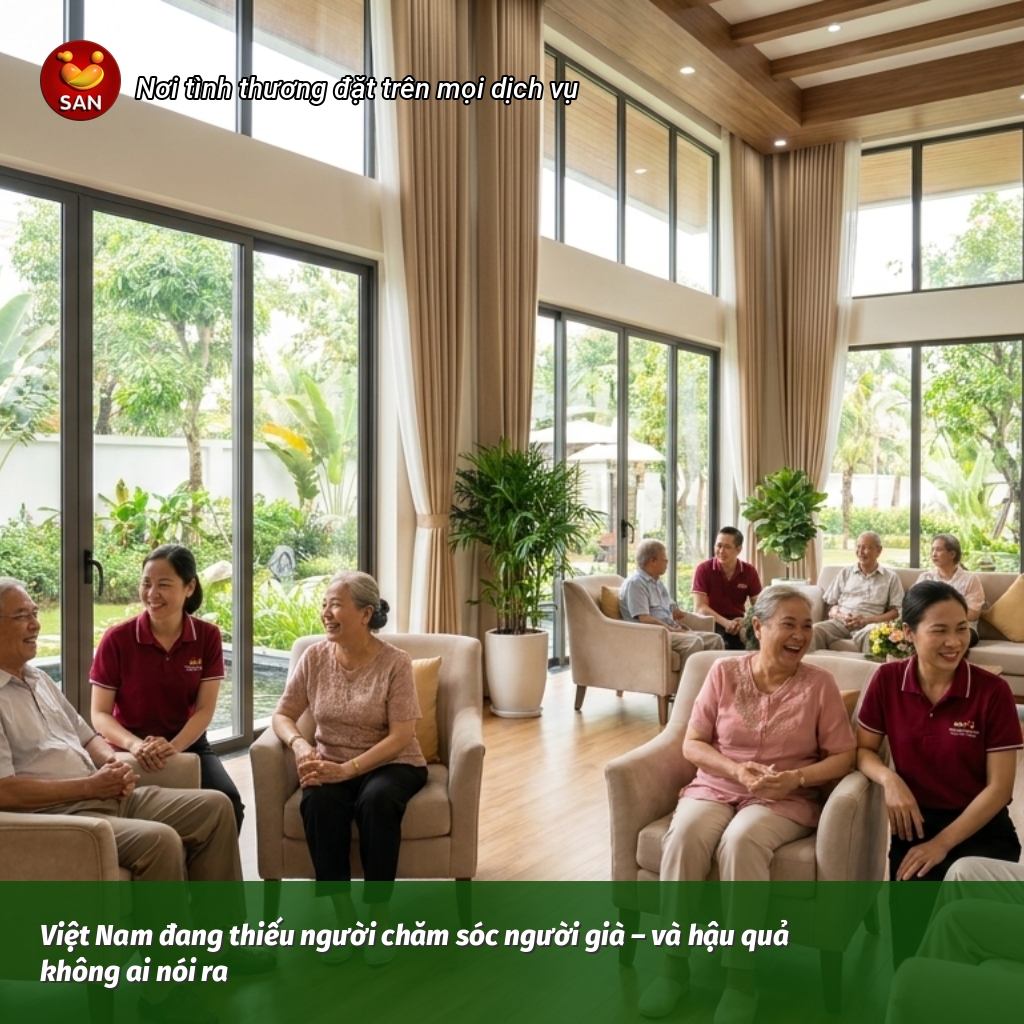
Vietnam is facing a shortage of caregivers for the elderly – and the consequences are unspoken.
If you ask any family what the most difficult thing is when a relative is elderly or seriously ill, the answer is very rarely money. The thing that exhausts them the most, lasts the longest, and is most difficult to resolve is something far simpler: the lack of someone to care for them.
It's not that I don't want to take care of her, but that I'm unable to.
Children work all day. Young people live far from home. Families are getting smaller and smaller. A patient needing 24/7 care is almost synonymous with another person completely sacrificing their own life. It might be manageable in the short term, but it's almost impossible to sustain in the long term.
That's why the demand for home caregivers has been increasing rapidly in recent years. But the paradox is: the more needed, the harder it is to find them.
It's not because there aren't enough people to do the job, but because there aren't enough people who are properly trained.
Currently, the majority of care comes from those who rely on experience – often acquaintances, relatives, or freelancers. They may be very diligent and dedicated, but they lack basic knowledge of medical care, handling situations, and monitoring the course of the illness.
This leads to a rarely discussed fact: many cases don't worsen because of the disease itself, but because of how it's cared for.
An elderly person recovering from a stroke requires a very specific exercise regimen. A patient recovering from surgery needs close monitoring for signs of infection. A person who is bedridden for a long time needs proper turning to prevent bedsores. These things cannot be learned through word of mouth, nor can they be done "by feel."
But due to a shortage of trained personnel, the family was forced to accept the risks.
On a larger scale, this is no longer just a story for individual families, but a "systemic gap."
Vietnam is entering a period of population aging. The number of elderly people is increasing rapidly, while the young workforce is trending downward. At the same time, the traditional family model – where multiple generations live together – is gradually disappearing. All these factors create immense pressure on the care system.
Meanwhile, hospitals are constantly overloaded and unable to handle long-term care. Nursing homes and care centers are starting to develop, but they are facing a severe shortage of staff.
In other words, the demand exists, but the supply hasn't yet materialized.
And this is the crucial point.
A market where demand is rapidly increasing but supply is insufficient always creates two parallel consequences: risks for service users, and opportunities for those who enter the market in the right way.
For families, the risk is choosing the wrong caregiver. For society, risk management is an important but unstandardized profession. But for those who see the trend, it's a huge opportunity.
Occupation caring for the elderly and patientsCarering, also known as nursing care, is gradually becoming one of the most in-demand professions in the future. This is true not only in Vietnam, but worldwide. In developed countries, caregivers are well-trained, certified professionals with established management systems and stable, even high, incomes.
What Vietnam lacks is not demand, but a training system.
And once that system starts to be built, the market will change very quickly.
Instead of "anyone can do the care," society will gradually shift to "only trained people should do it." Instead of choosing acquaintances, families will choose professionals. Instead of working haphazardly, those in professional fields will have a clear career path, stable income, and long-term development opportunities.
This is also the direction that platforms like SAN are pursuing: not only providing in-home care services, but also building a pool of well-trained caregivers through specialized academies. This addresses the needs of families while creating career opportunities for society.
Looking further ahead, this is not just a service industry, but a part of the future social infrastructure.
A society that can provide good care for the elderly and the sick is a more sustainable and humane society. And to achieve that, it cannot rely solely on kindness; it requires systems, training, and standards.
If you're struggling to find caregivers for a loved one, or are looking for a stable, meaningful, and in-demand career path, now is the time to start seriously exploring options.
Contact SAN for advice on in-home care services, or to learn about professional caregiver training programs.
SAN care platform


