
Tuition fees, class schedules, and class times at SAN Care Academy
When researching a course caring for the elderly or caring for the sickMost students have three initial questions: how long is the course, how much is the tuition fee, and does the class schedule fit their current job?
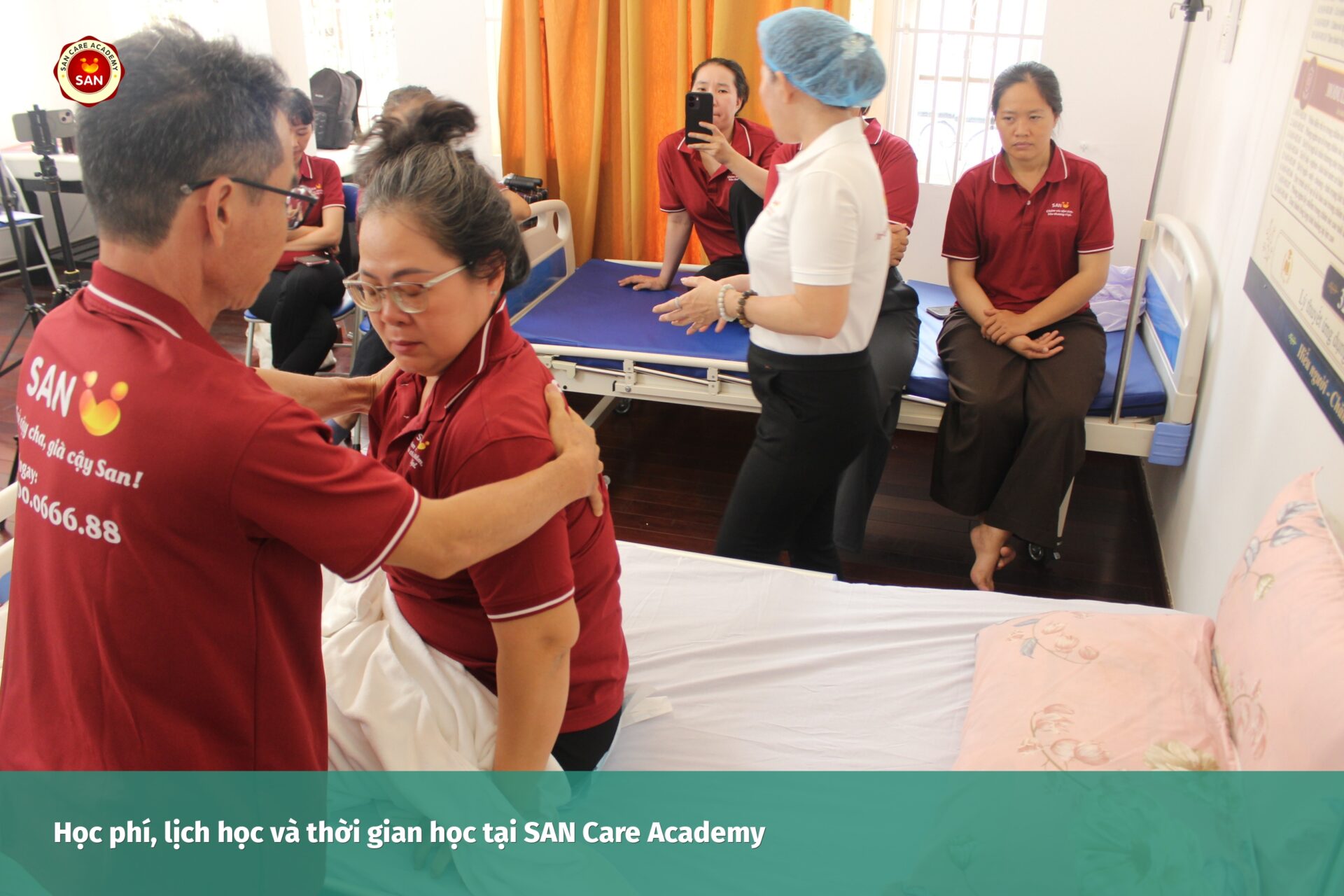
Those are very practical questions. Many people want to know. vocational training in childcare But they are still working, taking care of their families, considering the costs, or unsure whether they are suited to the profession.
SAN Care Academy We understand that students need more than just a course; they need a clear roadmap: what they are learning for, how long it will take, what they will learn, whether there will be practical application, whether they can intern, and how they can plan for future employment after the course.
Therefore, this page helps you understand the overview of tuition fees, class schedules, and study times at SAN Care Academy Before registering for a detailed consultation.
How long does it take to learn how to care for the elderly?
Time learning to care for the elderly It depends on the student's goals.
If Learn how to care for elderly parents at home.Trainees may need a concise program focusing on practical skills such as understanding the psychology of the elderly, assisting with eating, hygiene, mobility, preventing falls and choking, and recognizing abnormal signs.
If you study to get a job elderly care professionTherefore, trainees need a more structured curriculum. In addition to daily caregiving skills, trainees need to learn about professional conduct, professional ethics, communication with families, reporting on the situation, the limitations of non-medical caregivers, and practical skills.
If you study for home care for the sick.For patients recovering from a stroke or bedridden patients, the training time may vary because the content needs to delve deeper into preventing pressure ulcers, changing positions, assisting with hygiene, supporting safe eating, and observing for abnormal signs.
Therefore, SAN Care Academy SAN does not recommend a single study timeframe for everyone. Instead, SAN will provide advice based on each student's learning goals, experience level, and time management abilities.
What factors determine the duration of study?
Not all trainees need the same learning path. Some have years of experience caring for the sick but haven't received formal training. Others are complete beginners. Some are learning to get a job. Some are learning to care for their parents. Some want to learn quickly to start practicing sooner. Others need to learn at a slower pace because they are still working.
Study time at SAN Care Academy It usually depends on the following factors.
Learning objectives
If the program is for caring for family members, it may focus on essential household skills.
If studying to pursue a career in healthcare, students need to learn more about professional conduct, practical skills, ethics, reporting, and safety in caregiving.
If students are studying for practical training and long-term career development, they need to be better prepared before entering a real caregiving environment.
Previous experience
Someone who has experience caring for the sick. caring for the elderly Or, working as a caregiver for the sick may allow them to learn some practical skills more quickly.
However, experience cannot completely replace formal training. There are old habits that need to be adjusted to comply with safety principles and professional standards.
Beginners need to learn from the basics, but with a serious attitude and a willingness to practice, it's still possible to follow the path.
Selected course
Each course has a different level of depth.
The course on elderly care focuses on the psychology of the elderly, daily activities, fall prevention, choking prevention, communication, and reporting.
The home care course focuses more on supporting weak patients, hygiene, changing positions, preventing bedsores, observing abnormal signs, and limiting non-medical activities.
Courses on caring for stroke patients or bedridden patients often require more in-depth content on safe living support and risk prevention.
Students' practical skills
Caregiver profession Practice is needed. Some students grasp concepts quickly but need further practice. Some students can perform the tasks but need more communication skills. Some students are diligent but lack attention to detail in their reports.
Therefore, the duration of study is not only measured by the number of sessions, but also depends on how ready the student is to move on to the internship or employment phase.
Is the class schedule at SAN Care Academy flexible?
SAN Care Academy We understand that many students cannot study full-time. Some are working. Some are taking care of children. Some are taking care of parents. Some are only free in the evenings or on weekends.
Therefore, depending on the course and enrollment period, SAN can advise on more suitable class schedules for the group of students.
Class schedules can be designed as fixed-term classes, short-term courses, weekend classes, or a program suitable for working professionals, depending on the actual organizational conditions.
To find out the latest class schedule, please leave your information so SAN Care Academy can provide direct consultation. This consultation will not only let you know the class dates, but also which course best suits your goals.
Is it possible to work while studying?
This may depend on the student's schedule and ability to arrange their time.
Many people pursuing caregiving apprenticeships cannot immediately quit their jobs to attend full-time training. Therefore, a work-study or flexible learning plan is crucial.
If you are currently employed, SAN Care Academy We can advise on a more suitable study schedule, and help you understand which stages require foundational learning, which require practical application, and when you might be considered for supervised internships if appropriate.
It's crucial that students don't simply choose a course because it's the "shortest" or "available whenever they have free time." Caregiving involves dealing with the elderly, the sick, and their safety, so even flexible learning options require sufficient foundational knowledge and practical skills.
What does the tuition fee for the elderly care course include?
Tuition fees at SAN Care Academy should not be simply understood as the cost of "attending a few classes." Tuition reflects a comprehensive training program that includes knowledge, practice, guidance, assessment, and career counseling.
Depending on the course, tuition fees may include elements such as foundational learning content, study materials, practical guidance, skills assessment, learning path consultation, internship orientation, and job placement assistance if appropriate.
Each course has a different tuition fee depending on its duration, content, learning format, level of practice, and post-course learning path.
Therefore, to avoid misunderstandings, SAN Care Academy should advise on tuition fees directly based on specific needs. A course of study for employment will differ from one for caring for parents. Similarly, those learning to care for bedridden patients will have different needs than those learning basic elderly care.
Why shouldn't you choose a course based solely on its price?
Tuition fees are an important factor, especially for those looking to learn a trade to improve their income. However, in the field of elderly and sick care, choosing a course solely based on price can lead to students lacking practical foundations, safety knowledge, or career guidance after the course.
A good caregiving course is not just about teaching a few procedures. The course needs to help students understand the elderly, know how to provide proper care, know the limits of non-medical care, know how to prevent risks, know how to report problems, and practice the profession ethically.
If trainees receive only superficial training, they will easily become confused when they start working. Families will also find it difficult to trust caregivers who cannot explain things, report on their work, and demonstrate professionalism.
Therefore, instead of just asking "how much is the tuition fee?", students should also ask: what does the course cover, is there practical training, is there internship placement assistance, what kind of job placement advice will be provided after completion, and is it suitable for beginners?
Are there internships during the course of study?
For suitable students, after the initial foundational learning phase, SAN Care Academy can guide them towards supervised internships.
Internships help trainees become familiar with a real care environment, hone their demeanor, learn how to communicate with the elderly, patients, and their families, and gain a better understanding of the profession's requirements.
In some cases, eligible trainees may receive partial financial support during their internship. This support can help trainees reduce travel and food expenses or save time while familiarizing themselves with the practical work.
However, internships and financial support are not automatic commitments for all students. This depends on the program, academic performance, attitude, health, skills, and actual needs at each point in time.
Will I receive job placement assistance after graduation?
Yes. SAN Care Academy can provide career guidance to students to help them find suitable jobs after completing the course.
Trainees may be oriented towards jobs such as home care for the elderly, home care for the sick, assisting in the care of bedridden patients, caring for patients after strokes, working in nursing homes, care centers, or within the SAN care service ecosystem.
However, SAN does not guarantee jobs easily. Job opportunities depend on skills, attitude, health, academic performance, internship results (if any), and the specific requirements of each position.
SAN wants students to enter the caregiving profession with serious preparation, not with promises that are too beautiful but unrealistic.
What should I ask when discussing tuition fees and class schedules?
Before registering, students should ask for clarification on important details to choose the right course.
- You should ask whether the course is suitable for beginners or experienced learners, how long it lasts, what content is covered, whether there are practical exercises, whether internship opportunities are provided, whether a certificate is awarded upon completion, whether job placement assistance is offered, and what the tuition fee includes.
- If you are employed, you should also ask if there are evening or weekend schedules, or itineraries suitable for busy people.
- If you are studying to care for your parents, please clearly state your parents' situation so that SAN can advise you on the appropriate course content.
- If you are studying to get a job, please clearly share your age, experience, health, area of residence, and desired income so that we can provide more personalized advice.
Why should you schedule a consultation before making a decision?
Registering for a consultation doesn't mean you have to enroll immediately. This step helps students understand which course suits them best, the tuition fees, the duration of the course, and the post-course learning path.
Many people initially only ask about the price. But if you only know the price without understanding what the course offers, it's easy to perceive it as "high" or "low" without knowing if that price is suitable for your goals.
SAN Care Academy encourages students to seek advice beforehand to avoid choosing the wrong course, misunderstanding expectations, or enrolling when they are not truly ready.
A proper learning path will help students save time, save money, and be better prepared for a career in caregiving.
Frequently Asked Questions about Tuition Fees, Class Schedules, and Class Duration
How long does it take to learn how to care for the elderly?
The duration of study depends on the course and the student's goals. Those studying to care for their parents may need a different learning path than those studying to enter the workforce. You should schedule a consultation to receive guidance on a suitable study schedule.
How much does the course on elderly care cost?
Tuition fees vary depending on the course, duration, practical content, and post-course learning path. SAN Care Academy will advise on specific tuition fees based on each student's needs.
Are there evening or weekend classes?
Depending on the specific course start dates and programs, SAN can advise on suitable study schedules for working professionals or those with busy schedules.
Is it possible to work while studying?
If the student's study and work schedules allow, SAN can advise on a suitable learning path to help students prepare for a career in caregiving while simultaneously studying.
Does the tuition fee include practical training?
Depending on the course, practical content may be a significant part of the program. During the consultation, SAN will clearly explain what components the course includes.
Is it possible to have a supervised internship?
For suitable students, after the initial foundational learning phase, SAN may guide them towards supervised internships. Specific conditions depend on the program and the student's assessment.
Is the internship financially supported?
In some cases, eligible trainees may receive partial financial support during their internship. Specific details will be provided during the internship program.
Will I be offered a job after graduation?
SAN can provide career guidance to students to help them find suitable employment. Job placement depends on skills, attitude, health, academic performance, and the actual needs of each position.
If I'm studying to take care of my parents, do I need to study as comprehensively as I would a vocational course?
Not necessarily. If you're learning to care for your parents, SAN can advise on courses or content suitable for your family situation, focusing on home care skills and risk prevention.
Is there a fee to register for a consultation?
You can leave your information so that SAN Care Academy can advise you on suitable courses, tuition fees, schedules, and learning pathways before you decide to register.
Register to receive the latest tuition fees and class schedules.
If you are interested in courses on elderly care, home care for the sick, post-stroke care, or home care for elderly parents, SAN Care Academy can advise you on suitable tuition fees and schedules.
You can register to receive a consultation:
- The course is suitable for your personal goals.
- Tuition fees for each course
- Latest class schedule
- Course duration and practical content
- Supervised internship conditions
- Job placement opportunities after the course.
Register for a consultation today to receive information on tuition fees, class schedules, and a suitable study plan. SAN Care Academy.
Are you interested in learning childcare but unsure about tuition fees, schedules, and course duration?
Let SAN Care Academy advise you on a suitable learning path based on your goals, time constraints, and capabilities.


