
Student stories from SAN Care Academy
Each student who comes to SAN Care Academy They all have their own reasons.
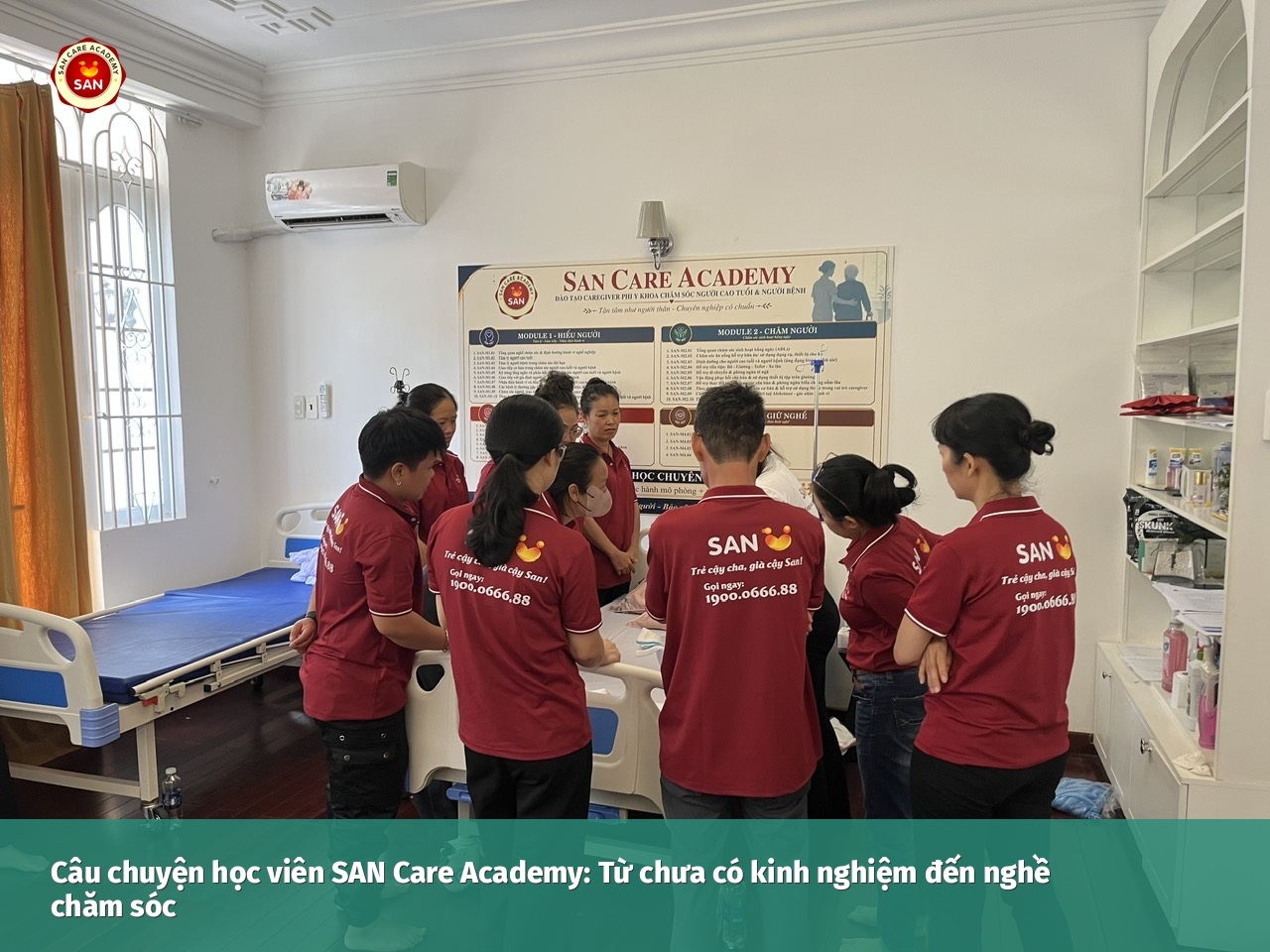
Some people want to learn a trade. caring for the elderly to get a more stable job. Some people used to work as domestic helpers but want to switch. more professional careSome people have experience caring for sick family members and want to learn the trade properly. Others want to learn how to care for their elderly parents more effectively. Still others have worked in various jobs and want to start a more meaningful profession.
What they all have in common is that they started with a very genuine question: "Can I learn this trade?"
SAN Care Academy doesn't just want students to complete a course. SAN wants students to understand the profession, hone their skills, know how to provide proper care, uphold professional ethics, and become more confident when entering the field of caring for the elderly and the sick.
From having no experience to knowing how to care for children properly.
Many trainees initially had no prior training in caring for the elderly or the sick. Some had only ever cared for their grandparents or parents at home. Others had never changed diapers, assisted bedridden patients for extended periods, or reported their condition to their families.
Initially, they often worry: they're afraid of making mistakes, afraid the elderly won't cooperate, afraid they won't be strong enough, and afraid they won't know how to do the job even after finishing the course.
Throughout the training process, trainees are introduced to each aspect: understanding the psychology of the elderly, assisting with eating, personal hygiene, changing clothes, changing diapers, assisting with mobility, preventing falls, preventing choking, observing and reporting abnormal signs.
Most importantly, students realize that caring is not just about getting the job done. Proper care is about doing it safely, gently, and respectfully for the person being cared for.
From domestic helper to skilled caregiver
Some trainees used to work as domestic helpers. They were familiar with cleaning, cooking, laundry, and assisting with household chores. But when they switched to caring for the elderly and the sick, they realized that this job required many additional skills.
Domestic help primarily involves maintaining the living space. Caring for the elderly and the sick is caring for people.
Caregivers need to be observant of the elderly person's complexion, meals, sleep patterns, gait, mood, signs of pain or fatigue, and subtle changes in daily routines. They also need to communicate effectively with the elderly, report to family members, and maintain non-medical boundaries.
For this group of students, SAN Care Academy helps them translate their life experiences into more standardized professional competencies.
From caring for loved ones to receiving formal vocational training.
Some students come to SAN because they have previously cared for parents, grandparents, or sick family members.
They have genuine compassion and experience, but they have also experienced many awkward situations: not knowing how to safely assist a patient, not knowing when to notify a doctor, not knowing how to handle an elderly person who refuses to eat, and not knowing how to change diapers without embarrassing the patient.
While studying at SAN Care AcademyThrough this process, they systematically review their past actions based on experience. They gain a clearer understanding of what they did correctly, what needs adjustment, and what they shouldn't do on their own.
Some people study to get a job. Others study to better care for their loved ones. Despite their different goals, the common thread remains: love alone isn't enough; you need to know how to care for them properly.
From anxiety to confidence during internship
For suitable students, after the initial foundational learning phase, SAN can guide them towards supervised internships.
The internship period helps trainees become familiar with a real care environment, encounter real situations, understand real pressure, and develop professional conduct.
Many trainees are initially afraid of internships. They fear not being skillful enough, dealing with difficult patients, or being judged by their families. However, with prior preparation in skills, communication, and professional ethics, trainees gradually become more confident.
Internships are not just about "trying out a job." Internships are an opportunity for students to gain a deeper understanding of the profession, discover which jobs suit them best, and identify areas for improvement.
What else do students learn besides skills?
Besides caregiving skills, many trainees say that what they learned most was how to view the elderly and the sick with more patience.
Previously, when elderly people were irritable, people easily assumed they were simply being difficult. When patients were uncooperative, people easily assumed they were deliberately being difficult. But after learning, they understood that behind it all could be pain, fatigue, fear, sadness, shame, or a feeling of losing control.
They also learned that professional ethics is not something abstract or unattainable. Professional ethics includes punctuality, honesty, maintaining family confidentiality, protecting property, clear reporting, and not taking on unauthorized work beyond one's scope.
These are the things that help caregivers stay in the profession longer.
These are the stories SAN wants to see.
SAN Care Academy wants to see students who know how to start with seriousness.
You don't need to be an expert from the start. But you do need to be willing to learn, correct mistakes, be punctual, honest, and respectful of the person you're caring for.
SAN wants to see people who used to be awkward at changing diapers now know how to be discreet with patients. People who used to be afraid to help the elderly walk now know how to check slippers, floors, and pathways. People who used to speak quickly now know how to give advance notice, ask gently, and listen. People who used to just want the job now understand that caregiving is a profession of trust.
Every small change like this is a valuable student story.
Testimonial suggestions are available on the website.
Beginner students
"Before the course, I thought caring for the elderly only required diligence. After the course, I understood that even small tasks like feeding, changing clothes, and helping them move around need to be done correctly to ensure the elderly are safe and feel less lonely."
The trainees previously worked as domestic helpers.
"I used to do housework for many years, but when I started learning elderly care, I realized it's a different profession. It's not just about cleaning or cooking; you have to be observant, report, and understand the psychology of the elderly."
Students learn to take care of their parents.
"I studied not to get a job, but to take care of my mother at home. What I remember most is that taking care of parents isn't just about love, but also about knowing how to talk to them and how to make them not feel like a burden."
Students go on internships.
"At first, I was very scared of going on my internship. But thanks to the prior training on communication, hygiene, fall prevention, and reporting, I felt less flustered when faced with a real situation."
Students who want to pursue a long-term career.
“After my studies, I understood that the caregiving profession requires kindness, but kindness alone is not enough. It also requires punctuality, honesty, the ability to keep family secrets, and staying within your purview.”
Why are student stories important?
The story of a student helps newcomers realize they are not alone.
Everyone has anxieties at the beginning. Everyone learning a trade is clumsy at times. But with the right guidance, proper practice, and a positive attitude, learners can progress step by step.
The trainees' stories also help families and society view the caregiving profession with greater respect. This is not a temporary job. It is a profession that requires skill, ethics, and perseverance.
SAN Care Academy hopes that after completing the course, each student will not only have more career opportunities but also a more humane perspective on the elderly, the sick, and the work of caregiving.
Register for a course consultation at SAN Care Academy
If you are also looking to start learning the profession of caring for the elderly or the sick, or want to learn how to properly care for your elderly parents at home, SAN Care Academy can advise you on a suitable path.
You can register to receive a consultation:
- The course is suitable for your personal goals.
- Latest tuition fees and class schedules
- Practical content in the course
- Supervised internship conditions
- Career guidance after the course
- Learning path for beginners
Sign up for a consultation today to begin your journey. vocational training in childcare In a systematic, practical, and valuable way.
What are you looking for? vocational training in childcare But I'm worried because I don't have enough experience?
Let SAN Care Academy We will advise you on a suitable learning path to help you start from the basics, practice correctly, and gradually build confidence.


