
Frequently Asked Questions about the Elderly & Sick Care Course
When researching the course elderly care, caring for the sick at home or learn the trade of being a caregiverMany students often have numerous concerns: can I learn without experience? How long does the course last? How much is the tuition fee? Is there practical training? Is there a certificate? Will I find a job after graduation? Will I get an internship?
These are all very practical questions. For many people, learning caregiving is not just about acquiring a new skill, but a decision that impacts their job, income, time, health, and career future.
SAN Care Academy We created this FAQ page to give you a clearer picture before you register for a course consultation.
I have no prior medical experience; can I still learn?
Maybe.
Learners do not necessarily need prior medical experience to begin learning skills in elderly care or non-medical patient care.
However, trainees need to be in good health, patient, serious, and have a genuine desire to learn. The caregiving profession requires not only diligence but also safe care practices, communication skills, observation skills, and reporting abilities.
SAN Care Academy It has a suitable learning path for beginners, helping students learn from the basics to practice.
Which course should a beginner take?
If you have no prior experience, you can start with a beginner's course in senior care or a basic home care course.
If your goal is to work in aged care, SAN can advise on a suitable training program in aged care, including practical training and internship opportunities.
If your goal is to care for elderly parents at home, you can choose a course on home care for elderly parents, focusing on the psychology of the elderly, daily living care, fall prevention, choking prevention, and communication within the family.
How long does it take to learn how to care for the elderly?
The duration of study depends on the course, learning goals, and the student's background.
Those learning to care for elderly parents at home may need a different training program than those learning to work in the profession. Those learning to care for bedridden patients or stroke patients also require more specialized content than basic elderly care.
SAN Care Academy We will advise you on the specific study schedule for each course, each start date, and your learning goals.
How much is the course fee?
Tuition fees vary depending on the program, duration, practical content, and post-course career path.
SAN Care Academy Students are not encouraged to choose courses based solely on their lowest price. What's important is whether the course aligns with your goals, includes practical training, offers internship opportunities, and helps you understand the caregiving profession properly.
To receive the latest tuition fees, please leave your information so SAN can directly advise you on the most suitable course.
Are there evening or weekend classes?
Depending on the recruitment period and training plan, SAN Care Academy There may be class schedules that suit working professionals or those with limited time.
If you need evening classes, weekend classes, or prefer a more flexible learning schedule, please sign up for a consultation so SAN can check the latest class schedules and suggest a suitable option.
Is it possible to work while studying?
It's possible, if your study and work schedules allow.
Many students are interested in a career in caregiving but are still working, caring for family, or have other personal responsibilities. Therefore, SAN can advise on a learning path that better suits the student's schedule.
However, despite flexible learning options, students still need to ensure they acquire sufficient foundational knowledge and practical skills, as the caregiving profession is directly related to the safety of the elderly and the sick.
Does the course include practical exercises?
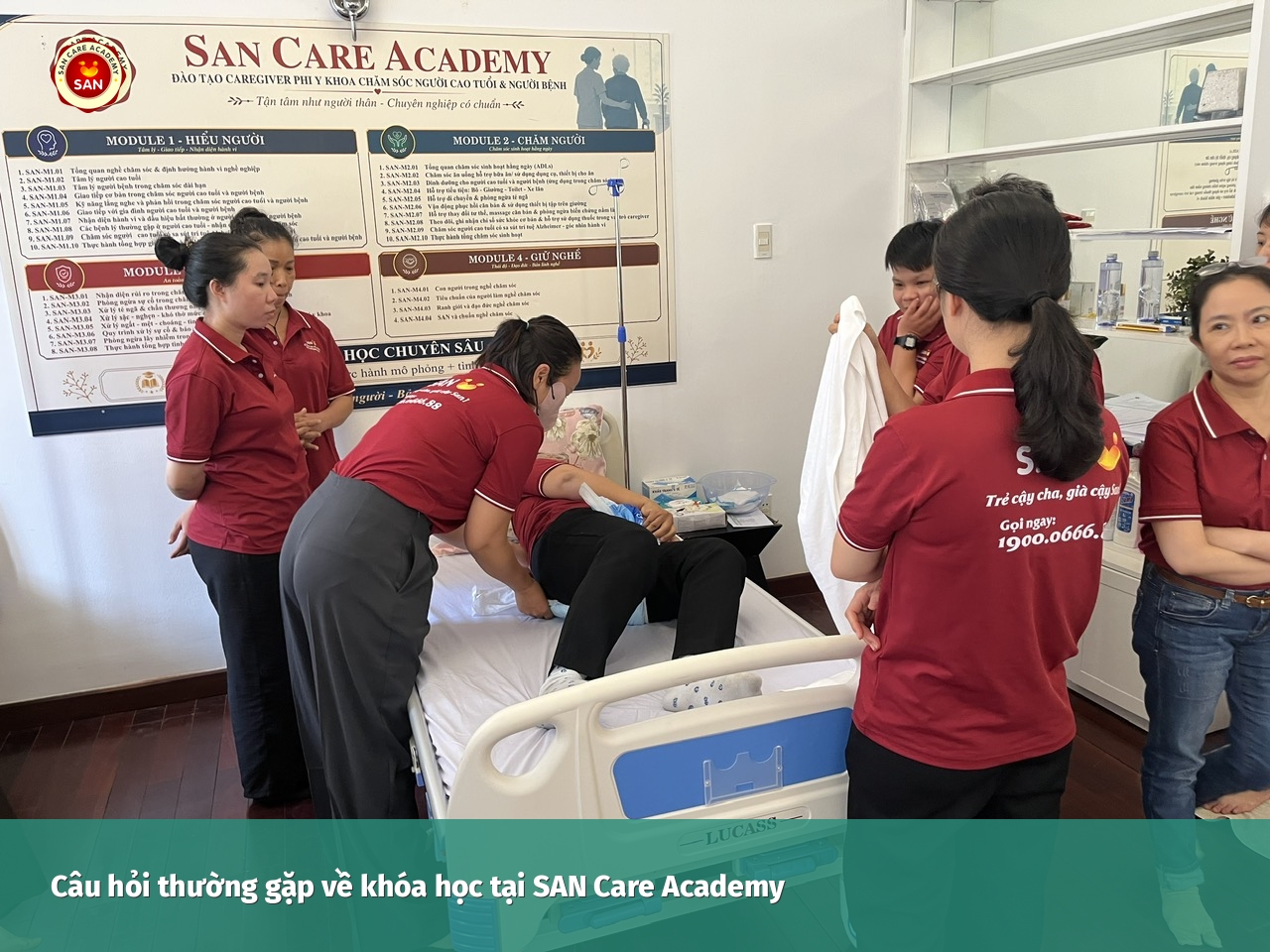
Yes. SAN Care Academy emphasizes practical experience because the caregiving profession cannot be learned solely through theory.
Trainees may be instructed in skills such as assisting with feeding, personal hygiene, dressing, changing diapers, assisting with mobility, changing positions, preventing falls, preventing choking, preventing pressure ulcers, observing for abnormal signs, and reporting to family.
The specific practical content will vary depending on the course.
Will I receive a certificate upon completion of the course?
Depending on the program, students who complete the course may receive a confirmation or certificate of completion.
The certificate demonstrates that the trainee has participated in the training program and received appropriate instruction in caregiving practices.
However, certification does not replace practical skills or medical qualifications. For long-term career success, trainees still need the necessary skills, attitude, professional ethics, suitable health, and the ability to meet job requirements.
Does having a certificate help with job applications?
A certificate of completion can support a student's resume when applying for jobs in aged care, sick care, or caregiver roles.
However, job opportunities don't depend solely on certification. Families and employers are also interested in the trainee's practical skills, attitude, honesty, communication abilities, health, and academic or internship achievements.
SAN Care Academy While it's possible to provide career guidance to students, certification should not be interpreted as an automatic guarantee of employment.
Will I get an internship after graduation?
For suitable students, after the initial foundational learning phase, SAN can guide them towards supervised internships.
Internships help trainees become familiar with a real caregiving environment, develop punctuality, communicate with families, practice caregiving skills, and gain a better understanding of the job requirements.
Internship opportunities depend on the academic program, academic performance, attitude, health, skills, and practical needs at any given time.
Is the internship financially supported?
In some cases, eligible trainees may receive partial financial support during their internship. This support can help trainees reduce travel and food expenses or time spent familiarizing themselves with the real-world environment.
However, financial assistance is not a fixed commitment for all students. Specific details will be provided based on the program and individual circumstances.
Will I be offered a job after graduation?
SAN Care Academy We can provide career guidance and advice to help students find suitable jobs.
Job opportunities may involve in-home aged care, in-home patient care, long-term care, post-stroke care, nursing homes, care centers, or the SAN care services ecosystem.
However, SAN does not guarantee automatic employment for all students. Employment depends on skills, attitude, health, academic performance, internship results (if any), and the actual needs of each position.
Does SAN have a job guarantee?
SAN Care Academy should not make easy job offers to all its students.
SAN aims to provide students with practical training, focusing on hands-on experience, professional ethics, internship orientation, and career counseling to help them find suitable employment.
The caregiving profession requires genuine competence, a genuine attitude, and a true fit for each task. Therefore, career guidance must be based on practical assessment, not just on whether trainees have completed a course.
Can people aged 40-50 learn?
Maybe.
The profession of caring for the elderly and the sick. It may be suitable for middle-aged people if they have adequate health, patience, a serious attitude, and the ability to work steadily.
Middle-aged individuals also have the advantage of maturity, good manners, and job stability. However, their health, mobility, and working hours need to be considered.
SAN Care Academy can advise on a suitable learning path based on each student's age and health condition.
Can men learn a trade in caring for the elderly and the sick?
Have.
Men can absolutely learn and work in the field of caring for the elderly and the sick, especially in cases requiring assistance with mobility, caring for critically ill patients, shift-based care, or assisting elderly men.
The important thing is not whether the trainee is male or female, but whether they possess the appropriate skills, attitude, health, honesty, and professional ethics.
Is learning how to care for elderly parents at home appropriate?
That's a perfect fit.
Not everyone who studies at SAN Care Academy is studying to work in the profession. Many are studying to better care for their parents, grandparents, or other relatives at home.
The course helps families understand the psychology of the elderly, providing support with eating, hygiene, mobility, fall prevention, choking prevention, recognizing abnormal signs, and communication to alleviate feelings of loneliness and isolation in parents.
Caring for elderly parents requires more than just love. Proper care ensures their safety and reduces awkwardness for the family.
What can non-medical caregivers do?
Non-medical caregivers can assist with daily activities such as eating, personal hygiene, dressing, diaper changes, mobility assistance, position changes, maintaining a clean environment, monitoring for unusual signs, and reporting them to the family.
Non-medical caregivers are not replacements for doctors, nurses, or other healthcare professionals. Therefore, it is important to understand the limitations of their role.
What should non-medical caregivers avoid doing?
Non-medical caregivers should not prescribe, change, discontinue, administer injections or infusions, treat complex wounds, debride ulcers, diagnose illnesses, perform intensive rehabilitation exercises, or change diets without appropriate guidance.
If any unusual signs are observed, caregivers should notify family members or appropriate healthcare professionals and not attempt to handle the situation themselves.
Does the course teach professional ethics?
Yes. SAN Care Academy considers professional ethics a very important part of its training.
Trainees learn about honesty, punctuality, clear reporting, maintaining family confidentiality, protecting property, respecting those under their care, avoiding personalizing unpleasant remarks, and refraining from working beyond their assigned scope.
Caregiving is a profession built on trust. Therefore, skills must go hand in hand with professional ethics.
Is there a fee to register for a consultation?
You can leave your information so that SAN Care Academy can advise you on suitable courses, tuition fees, schedules, and learning pathways before you decide to register.
We provide guidance to help you understand which course best suits your goals: learning for employment, learning for internships, learning to care for loved ones, or learning to improve your skills.
What should I prepare before registering for the course?
You should define your learning goals: are you learning to get a job, to care for a loved one, to change careers, or to improve your skills?
Additionally, you should prepare information about your age, previous experience, available study time, living area, personal health, and post-course expectations.
The more detailed your information is, the easier it is for SAN Care Academy to advise you on a suitable learning path.
How is SAN Care Academy different from a typical short-term course?
SAN Care Academy doesn't just offer training where you finish the course and that's it. SAN builds its program from the practical experience of caring for the elderly and the sick at home within the SAN ecosystem.
Trainees learn practical skills, safe care practices, geriatric psychology, professional ethics, reporting to family members, and non-medical limitations.
For suitable students, SAN can provide supervised internships and career counseling after the course.
Register for a course consultation at SAN Care Academy
If you have any further questions about courses in aged care, patient care, certification, internships, tuition fees, schedules, or job opportunities, SAN Care Academy can provide direct consultation.
You can register to receive a consultation:
- The course is suitable for your personal goals.
- Latest tuition fees and class schedules
- Course duration and practical content
- Supervised internship conditions
- Course completion certificate information
- Career guidance after the course
Sign up for a consultation today to get clear answers to your questions before starting your caregiving training.
Do you have any further questions about tuition fees, class schedules, certification, internships, or job opportunities after the course?
Let SAN Care Academy We will advise you on a suitable career path based on your goals, age, experience, and available time.


