
SAN Care Academy – Training Academy for Elderly and Patient Care
Caring for the elderly and the sick. It's not just about being present. It's a job that requires skill, patience, compassion, and the ability to handle small situations correctly, which can easily turn into big risks.
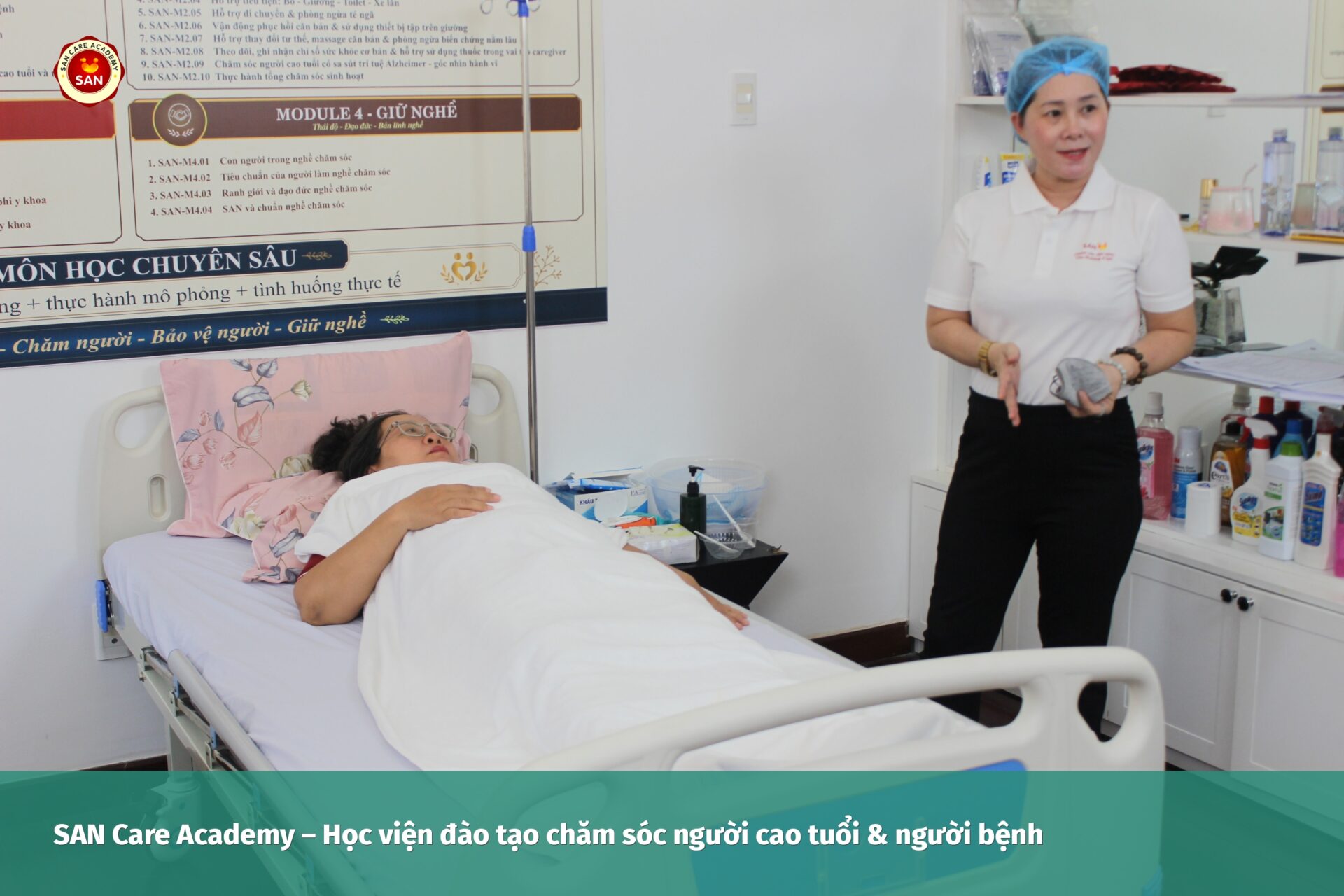
SAN Care Academy It was born from a very real need of many families: the need for a helper. caring for the elderly and the sick. It's not just about health, but also about knowing how to provide proper care, communicating gently, preventing risks, and preserving the dignity of those being cared for.
With a focus on practical training, SAN Care Academy It not only helps students learn a course, but also helps them gradually enter the caregiving profession in a systematic, standardized, and valuable way.
Learn how to care for others properly – a valuable profession.
Elderly care profession And the need for caregivers is becoming increasingly important in today's society. As parents age, as patients require support at home, and as family members cannot be present all day, the role of caregivers becomes crucial.
But caring for the elderly is not simply about helping them stand up, feeding them, changing their clothes, or sitting beside them to chat. If done incorrectly, even a small action can cause falls, choking, pressure sores, psychological trauma, or make the person being cared for feel a loss of self-esteem.
So, SAN Care Academy The training program should be designed with the following focus: learning to understand people, providing the right skills, ensuring safety, and upholding professional ethics.
SAN Care Academy's training message is:
Learn how to care for others properly – practice under supervision – create a valuable profession.
Who is SAN Care Academy for?
SAN Care Academy Suitable for a wide range of student groups, especially those looking for a practical, stable, and meaningful career.
This course is suitable for those who want to... learn a trade in elderly care For those seeking employment, individuals who have previously worked as domestic helpers or caregivers but lack formal training, and those wishing to transition to other professions. elderly care professionMiddle-aged people want a career that is more suitable to their current circumstances, and children want to learn how to care for their elderly parents at home.
Many students who come to SAN don't start with medical experience. They start with a desire for a decent profession, a useful job, and a real work opportunity. Most importantly, students have a serious attitude, patience, a willingness to learn, and a desire to properly care for others.
Main courses at SAN Care Academy
Elderly care training course
This course is for those who want to learn a trade. caring for the elderly, elderly care at home, at nursing homes, care centers, or within the SAN care services ecosystem.
Trainees learn about the psychology of the elderly, assistance with eating, personal hygiene, dressing, mobility, fall prevention, choking prevention, pressure sore prevention, and respectful communication with the elderly.
Home Patient Care Course
This course is for those who want to learn how. caring for the sick At home, assist patients with daily activities, monitor for basic symptoms, and know when to notify family or healthcare professionals.
The course content focuses on practical skills such as assisting with eating, hygiene, changing posture, assisting with mobility, risk prevention, and communication with others. patients.
Course on caring for patients after stroke
Patients recovering from a stroke often require careful support with eating, mobility, hygiene, communication, and the resumption of daily activities. If caregivers don't understand the risks, patients may be at risk of falls, choking, bedsores, or psychological trauma.
The course helps participants understand the basic considerations when caring for patients after a stroke, and also understand the limitations of non-medical caregivers so that they do not independently perform tasks beyond their professional expertise.
Course on caring for bedridden patients
Bedridden patients require meticulous care in every detail: turning, changing diapers, personal hygiene, changing bed sheets, assisting with eating, preventing pressure sores, and monitoring for any abnormalities.
This course helps students understand that caring for bedridden patients requires not only physical strength, but also technical skills, gentleness, carefulness, and a respectful attitude towards the patient.
Elderly care course for beginners
This course is suitable for those with no prior experience who want to begin learning elder care in a structured way.
Trainees will be guided from the most fundamental knowledge: understanding the psychology of the elderly, providing basic care, communicating appropriately, preventing risks, practicing procedures, and developing professional conduct.
Course on caring for elderly parents at home.
Not everyone who studies geriatric care intends to make a living from it. Many study it because they want to care for their elderly parents in a more appropriate way.
This course is for family members who want to understand how to care for their elderly parents, especially when they are frail, sad, prone to falls, have difficulty eating, or need assistance with daily activities.
Caring for elderly parents is not just about love. Proper care helps parents feel safer, less lonely, and maintain their dignity in their old age.
What do students learn at SAN Care Academy?
Training program of SAN Care Academy It is built around four pillars: Understand people – Care for people – Protect people – Preserve traditional crafts.
Understanding people
Before caring for the elderly or the sick, trainees need to understand the person they are caring for.
Older adults may be repetitive, fussy, sad, irritable, or uncooperative. Patients may be tired, anxious, self-conscious, or vulnerable. If caregivers do not understand this psychology, they are very likely to personalize the words and behavior of the person being cared for.
SAN Care Academy This helps students understand that many of the reactions of the elderly and the sick are not because they are "annoyed," but may stem from age, illness, dependence, fear of losing independence, or a feeling of being a burden.
Understanding this, caregivers will be calmer, gentler, and provide care with respect.
Caring for people
Caring for the elderly and the sick. It starts with very ordinary things: meals, drinks, sleep, personal hygiene, changing clothes, changing diapers, helping to sit up, assisting with mobility, talking and observing daily conditions.
But every little thing needs to be done right. Helping someone up incorrectly can cause falls. Feeding too quickly can cause choking. Changing diapers without discretion can embarrass the elderly. Saying something thoughtless can upset a patient all day.
Therefore, trainees are instructed to provide care using both skills and attitude. They must perform the procedures correctly, but also maintain discretion, gentleness, and respect.
Protect people
A good caregiver not only knows how to do their job, but also knows how to prevent risks.
SAN Care AcademyThe program trains students to identify common risks in caring for the elderly and sick, such as falls, choking while eating, pressure ulcers, infections, use of unsafe equipment, poorly arranged homes, or patients showing unusual symptoms that are not reported promptly.
Trainees were emphasized the principle that non-medical caregivers should not self-diagnose, self-medicate, or handle situations beyond the scope of their instructions. If any unusual symptoms appear, they should notify family members, their caregiver, or appropriate healthcare professionals.
Preserving the craft
The caregiving profession requires not only skillful hands but also professional integrity.
Caregivers must be honest, punctual, report promptly, safeguard family property, respect privacy, maintain confidentiality, and behave kindly even when the person being cared for is not feeling well.
Compassion is important, but to have a long-term career, caregivers also need discipline, composure, and professionalism.
SAN Care Academy trains students not only to "know how to care," but also to "keep the profession."
Learning pathway at SAN Care Academy
Step 1: Initial consultation
Before starting their studies, students receive counseling to determine their goals: studying to get a job, studying to care for family members, studying to improve their skills, or studying to change careers.
Orientation counseling helps students choose the right course, understand the job requirements, and have realistic expectations before starting.
Step 2: Learn the basics
Trainees learn fundamental knowledge about the psychology of the elderly and the sick, skills in providing care and daily living, safety in caregiving, communication, and professional ethics.
This stage helps learners build a solid foundation, avoiding habitual or anecdotal care practices that may not be safe.
Step 3: Practice the skills
The caregiving profession cannot be learned solely through lectures. Trainees need to practice procedures, handle situations, and develop communication skills in contexts close to real-life scenarios.
SAN Care Academy emphasizes hands-on practice so that students not only "understand the lessons," but also know how to perform each task carefully.
Step 4: Supervised Internship
For suitable trainees, after the initial foundational learning phase, SAN can guide them towards supervised internships. This phase helps trainees become familiar with a real care environment, develop professional skills, and may receive some financial support during their internship.
Supervised internships not only help trainees gain more confidence, but also allow SAN to assess their attitudes, skills, and suitability for real-world caregiving work.
Step 5: Career Guidance
After the course, suitable participants may receive career guidance in environments such as: home care for the elderly, home care for the sick., nursing homes, senior care centers, or SAN's ecosystem of care services.
SAN Care Academy doesn't make easy promises of guaranteed employment simply by completing the course. However, SAN is committed to providing practical training, helping students understand the profession, hone their skills, and better prepare them for employment.
What can I do after graduating?
Upon completing the course and meeting the relevant requirements, students can pursue careers related to caring for the elderly and the sick.
Trainees can work as caregivers for the elderly at home, home-based patient care, nursing home support staff, senior care center caregivers, post-surgical patient care, stroke patient care, bedridden patient care, or work within the SAN ecosystem if they meet the selection requirements.
Furthermore, for students learning to care for family members, the knowledge gained from the course can help families care for elderly parents more effectively, safely, and avoid many common mistakes in home care.
Can I learn even without experience?
The answer is yes, it's possible.
Trainees without prior medical experience can still begin learning to care for the elderly or the sick, provided they are in suitable health, have a serious attitude, patience, and the right learning mindset.
The caregiving profession is not simply about being "hardworking." Learners need systematic instruction to know what to do, what not to do, when to report to their supervisor, and what the boundaries of non-medical caregiving are.
SAN Care Academy is particularly suitable for beginners because the program is structured step-by-step, from foundation to practice, from basic skills to professional conduct.
Why choose SAN Care Academy?
SAN Care Academy has the advantage of being built within SAN's real-world care ecosystem. This ensures that the training program is grounded in reality and closely follows common situations encountered in caring for the elderly and sick at home.
Students not only learn theory, but also gain access to practical thinking, real-world scenarios, communication skills, safety procedures, and professional ethics.
SAN understands that a family needs more than just someone to "be by" the elderly. The family needs someone who is observant, knows how to report, knows how to provide careful care, knows how to manage property, knows how to respect the patient, and knows how to work responsibly.
Therefore, SAN Care Academy trains caregivers to be skilled, have the right attitude, and meet high standards.
Frequently Asked Questions about SAN Care Academy
I have no experience, can I still learn?
Yes. SAN Care Academy offers courses for beginners. Students will be guided from the basics to practical application, provided they have a serious attitude and are in suitable health.
How long does it take to learn how to care for the elderly?
The duration of study depends on the course, learning objectives, and practical training plan. You can leave your information so SAN can advise you on suitable study schedules, tuition fees, and times.
Does the course include practical exercises?
Yes. SAN Care Academy emphasizes practical training because the caregiving profession cannot be based solely on theory. Students need to practice real-life procedures, situations, and communication skills.
Will I receive a certificate upon completion of the course?
Depending on the program, students who complete the course may receive a certificate of completion. The certificate demonstrates the learning process, but for long-term career success, students still need practical skills, a positive attitude, and real-world relevance.
Will I be offered a job after graduation?
SAN Care Academy We provide internship and job placement guidance for students. Job opportunities depend on their abilities, attitude, health, academic performance, and the practical requirements of each position.
Is it possible to work while studying?
Depending on the course schedule, SAN can advise on a suitable learning path for working professionals, those with limited time, or those who want to learn in stages.
Can people aged 40-50 learn?
Yes, it's possible. The profession of caring for the elderly is suitable for many age groups, as long as the learner has suitable health, a kind attitude, patience, and a serious desire to pursue the profession.
Is learning how to care for elderly parents at home appropriate?
That's a great fit. SAN Care Academy has content geared towards families who want to learn how to properly and safely care for their elderly parents, and to minimize their feelings of loneliness and sadness.
Register for a course consultation at SAN Care Academy
If you are looking to learn elderly care, home care for the sick, for employment, or to properly care for your elderly parents, SAN Care Academy can advise you on a suitable path.
You can register to receive a consultation:
- The course is suitable for my goals.
- Latest tuition fees and class schedules
- Study time and practical training schedule
- Supervised internship conditions
- Job placement opportunities after the course.
Sign up for a consultation today to begin learning the profession of caring for the elderly and the sick in a systematic, practical, and valuable way.
Not sure which course to take?
Let SAN Care Academy advise you on the right path: learning to work, learning to care for loved ones, learning for internships, or learning to develop a long-term career in caregiving.


