
Post-stroke care – the critical phase for recovery.
The crisis doesn't end when patients Leaving the hospital.
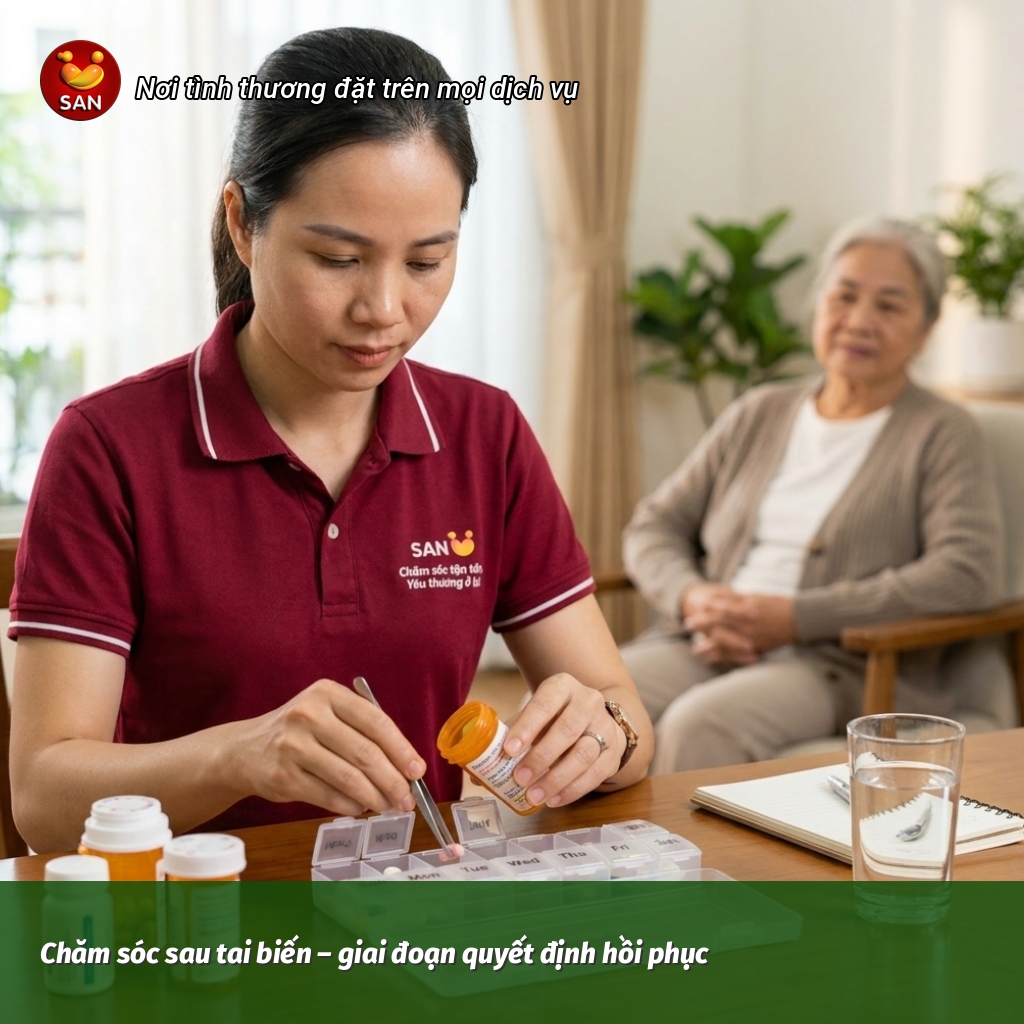
In fact, the most important process begins afterward.
Many families think that after being discharged from the hospital, all they need to do is... Take the patient home. With proper care, they would recover. But after a short time, they began to realize something:
Post-stroke care is not as simple as they think.
This is a stage where every small action can affect the long-term outcome.
A slight deviation in movement can cause muscle stiffness. An inappropriate diet can hinder recovery. An overlooked abnormality can lead to complications.
The hardest part is that these mistakes don't happen all at once.
They accumulate gradually over time.
And by the time you realize it, recovery becomes much more difficult.
One of the most common mistakes is thinking that the more care you take, the better.
The family tries to get the patient to eat more, exercise more, and do everything else more. But as analyzed in the article "The more you care, the worse the illness," the problem lies not in the level of care, but in the way it is done.
After a stroke, the patient's body is very sensitive.
Each stage requires a different approach. A single method cannot be applied to the entire process.
This is why Post-stroke care Knowledge is needed; experience alone is not enough.
Many families still choose to hire "female caregivers" because they are easy to find and quick to respond to. However, in the aftermath of a medical emergency, this poses a significant risk.
It's not because the caregivers aren't dedicated, but because they haven't been trained to handle these specific situations.
They may not know how to properly assist mobility. They may not recognize danger signs. And they may not know when medical intervention is needed.
Meanwhile, these are the factors that determine a patient's ability to recover.
One caregiver Those who receive training will have a completely different approach.
They don't just do things out of habit, they do them according to principles.
They know when to provide support and when to let the patient manage on their own. They know how to observe and adjust their approach at each stage. More importantly, they know their limits and when to alert the medical team.
In SAN care platform at home, the caregiver They all received training through SAN Care Academy before participating in caregiving, especially with these cases. after a stroke.
This helps ensure that caregivers have sufficient knowledge and skills to support them during this crucial period.
Furthermore, caregivers do not work alone.
They have support from the system, can communicate when facing difficulties, and can be replaced when needed. This helps families avoid being completely dependent on a single individual.
Another important point is patience.
Recover after a stroke It's not a quick process. It can take months, even years. During that time, the patient needs consistent, uninterrupted care.
This is something that spontaneous models find very difficult to guarantee.
Post-stroke care It's not just about physical support, but also about mental support.
Patients may feel insecure, dependent, or depressed. caregiver Being fit not only helps them stay active, but also helps them maintain the motivation to continue.
If you're at this stage, the most important thing isn't finding the fastest person, but finding the right person.
Making the right choice from the start can make a huge difference in the recovery outcome.
Contact SAN for service consultation. post-stroke care Suitable to the family's actual situation.
SAN care platform


