
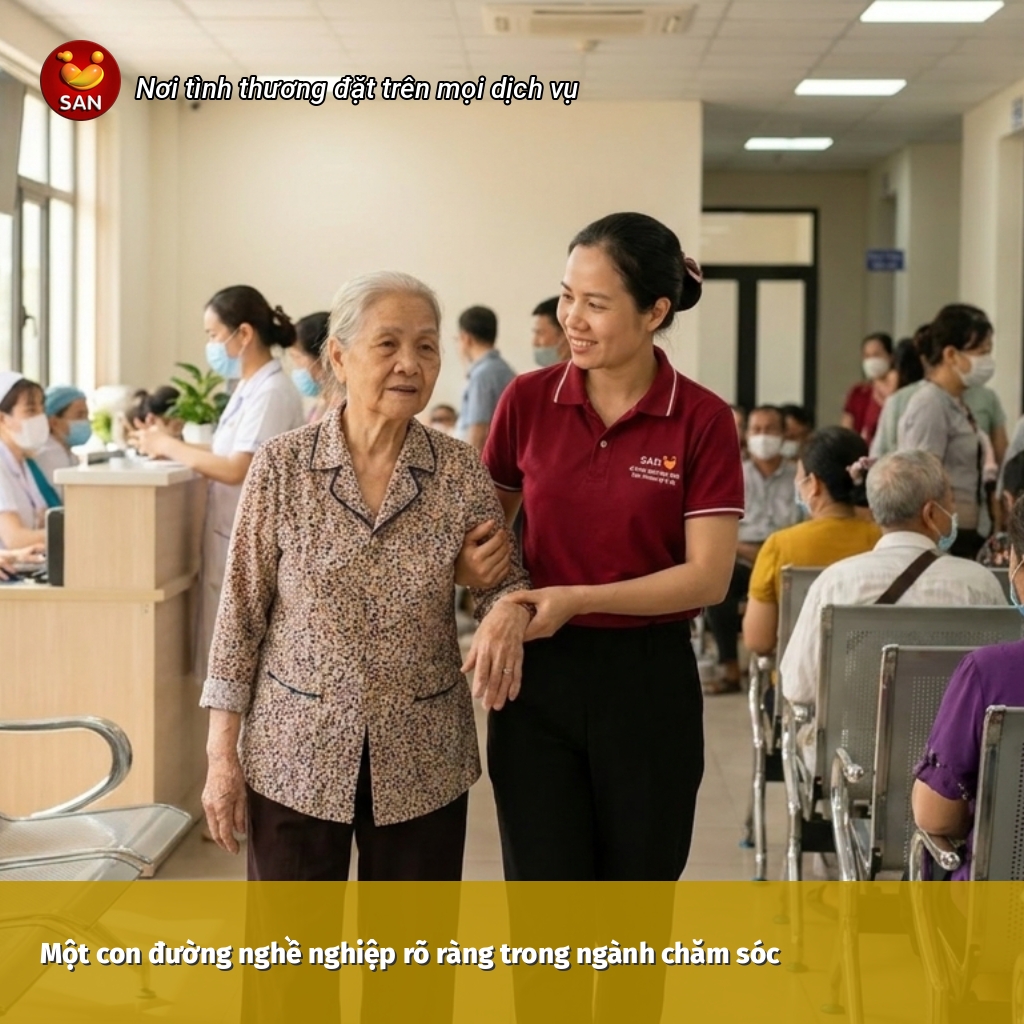
A clear career path in the care industry.
There's a phase that many people go through.
After working for a few years, I realized my current job is no longer a good fit. My income hasn't increased. The pressure has only grown. But I don't know where to start again.
For those who don't have a strong academic background, "changing careers" becomes even more difficult.
It's not because I don't want to change.
Because we couldn't see a clear enough path.
In that context, many people choose to continue in their current jobs. Not because they are satisfied, but because they have no other options.
But in reality, there are professions that are not often mentioned, yet are opening up huge opportunities.
One of them is the industry caring for the elderly and patients.
A growing need that few people notice.
Society is aging.
The number of elderly people is increasing rapidly, while families are becoming busier than ever. Taking care of a loved one for extended periods is becoming more difficult than before.
This creates a huge demand for caregivers – people who directly care for the elderly and the sick.
But the paradox is:
Demand is increasing, but there is a shortage of trained personnel.
Much of the current market still relies on an informal model, often referred to as "group caregivers"—people who provide care based on experience rather than formal training.
This leaves a huge gap:
- The family needs a skilled caregiver.
- But those working in the profession have not received proper training.
And this is where a career begins.
When an industry has high demand but a shortage of qualified professionals, it's often a sign of opportunity.
It's not about quick opportunities, but about sustainable opportunities.
The profession of caring for the elderly and the sick has a very unique characteristic:
- Not dependent on trends
- Not easily replaceable.
- The longer the time, the more will be needed.
This is not a glamorous profession.
But it is a profession that can generate a stable and long-term income.
And more importantly, it's a profession with clear meaning.
But the problem isn't knowing the trade – it's knowing where to start.
Many people, when they hear about the job of a caregiver, will think:
"I don't know anything about it, can I still do it?"
This is a very practical question.
Because, unlike simple tasks, caring for the sick and old person It requires the right knowledge, skills, and approach.
It cannot be done with dedication alone.
And this is also the difference between caregiver They are trained and "care for the flower girls".
One side relies on experience.
One side follows the system.
The results also vary greatly.
SAN Training Academy – More Than Just a Vocational School
SAN Training Academy It was not designed to "teach a course".
The goal is to create a clear path for those who want to enter this industry.
Instead of learning theory and then finding a job on your own, the model is designed as follows:
- Learn → Practice → Get a job
Students not only learn knowledge, but also receive training in skills, psychology, and professional ethics.
More importantly, there are 100 hours of paid internship, helping students transition from "knowing" to "being able to do" while still in the learning process.
Upon completion, trainees can join the SAN caregiving ecosystem – where there is a ready-made demand.
This helps reduce the biggest risks when learning a trade:
- Finished studying but don't know where to go.
One profession – many paths
Unlike many jobs that are limited, caregiver There are many options:
- Work at the hospital
- Working at a nursing home
- Home care
- Working as a freelancer within the system SAN
- Become a permanent employee
This creates a great deal of flexibility.
You're not "stuck" in one place.
Income isn't the only thing – but it's something that needs to be clear.
One of the biggest questions is:
"Is this job enough to make a living?"
The answer is: yes – if you go in the right direction.
In SAN, where caregivers focus on the elderly and the sick, many can achieve a stable income, even exceeding 20 million VND per month when working consistently.
This doesn't come from "luck," but from:
- real needs
- real system
- real work
Not everyone needs it – but if you're looking for an escape route...
It needs to be clarified:
Not everyone needs to learn this trade.
But if you are in a phase:
- My current job is unstable.
- insufficient income
- No clear direction in sight.
- I want to start over but don't know where to begin.
This is an option worth considering.
Not because it's easy.
Because it's clear.
Conclude
A career path doesn't need to be "perfect."
But it needs to be clear enough for you to take the first step.
Among the many options out there, the field of aged and sick care is becoming a more practical career path than ever before.
It's not because it's talked about a lot.
Because it really needs people.
If you're considering starting over, perhaps what you need isn't a big decision.
But it's a proper starting point.
Contact SAN for detailed advice on study pathways and career opportunities at SAN training academy.
Hotline: 1900.0666.88
SAN care platform


