
WHICH PROFESSIONS ARE UNDEFEATED BY ANYONE IN THE NEXT 10 YEARS?
In recent years, artificial intelligence (AI) has developed very rapidly. Many jobs that previously required human labor can now be automated or partially replaced by machines.
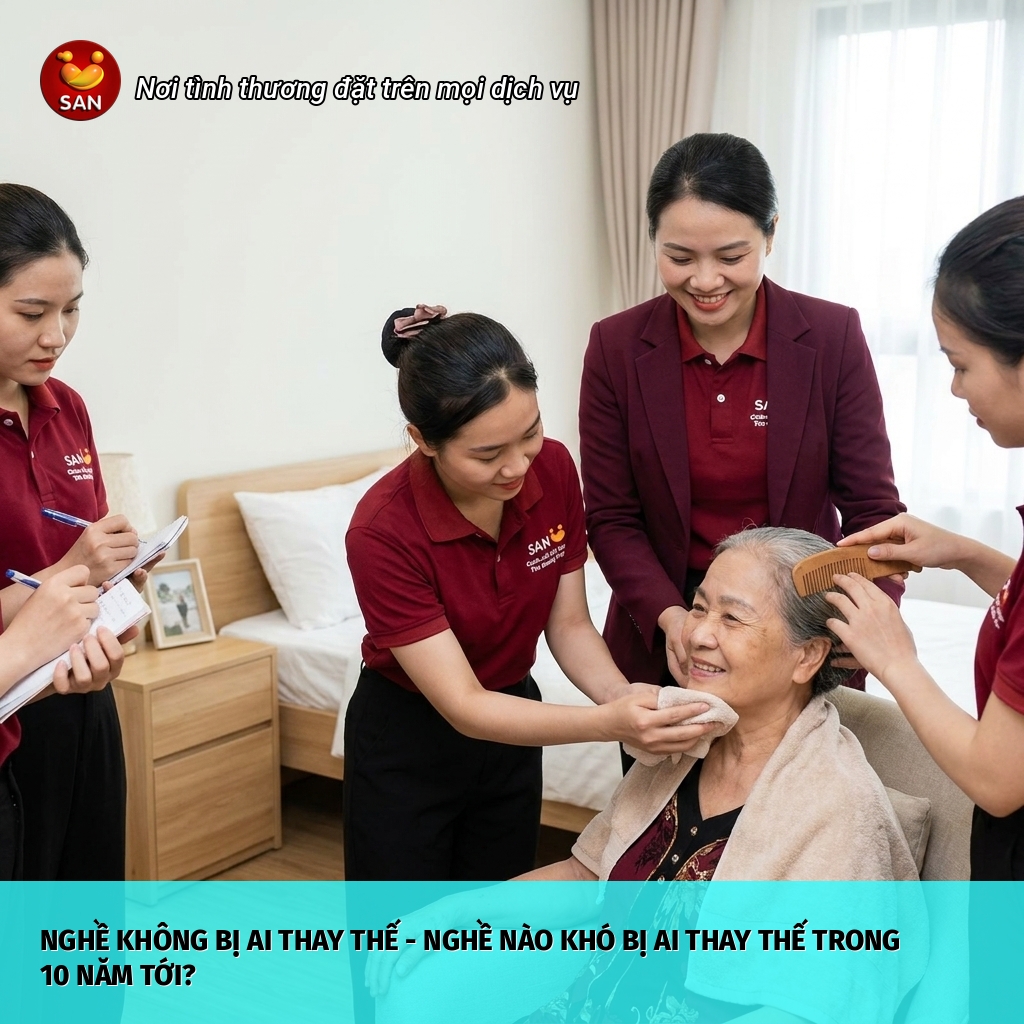
This has led many people to start worrying: will their current profession still exist in the future? If they learn a trade now, will it be replaced in a few years?
This is a very practical question, especially for those who are career guidance or are considering a career change.
However, not all jobs are at risk of being replaced by AI.
There is a group of professions with very distinct characteristics: they require direct human presence, emotional connection, flexible problem-solving skills, and trust. These are elements that current technology finds very difficult to completely replace.
Fields such as healthcare, caregiving, education, counseling, or hands-on practice are consistently rated as highly sustainable occupations.
Among them, The profession of caring for the elderly and the sick. This is a prime example.
This job relies not only on skill, but also on patience, observation, and the ability to understand people. You're not just working with "diseases," you're working with "people."
An elderly person needs not only physical care, but also needs to be listened to, reassured, and treated as a human being with emotions. These things cannot be completely programmed.
Which professions are least likely to be replaced by AI?
AI can assist in health monitoring, medication reminders, or providing information. But AI cannot replace holding a hand. patientsTheir presence is irreplaceable when they need someone by their side.
This is why caregiving It is considered one of the professions that is difficult to replace in the long term.
Furthermore, this profession is in increasing demand. Society is aging, and the number of elderly people is growing. This makes the need for caregiving a long-term need, independent of economic cycles or technological trends.
An important point is that this profession does not require a college degree. You can take short-term apprenticeships, learn a trade quickly, and start working shortly after.
Current training programs often follow a work-study model, allowing learners to gain practical work experience and earn income while studying.
After completing the course and obtaining a certificate in aged care, certificate in elderly care With a caregiving certificate or certification, you can work in a variety of settings: nursing homes, hospitals, medical facilities, or care systems.
This is a huge advantage over technology-dependent professions, where you're constantly having to keep up with change.
In the context of AI development, the way people choose their careers also needs to change. Instead of choosing a "hot" career in the short term, many people are starting to... choosing a career It can last a long time.
Professions that require practical skills, presence, and human interaction will become increasingly valuable.
In SAN Care AcademyThe training program is designed with a practical focus, enabling learners to quickly get started and work long-term in a stable profession.
You can find out more at
Learn elderly and sick care at SAN Care Academy.
In a rapidly changing world, sustainable occupation It's not that the profession is unchanging, but rather that it always needs people.


