
Hospital Companion & Post-Treatment Care in Ho Chi Minh City: A Guide for Overseas Vietnamese
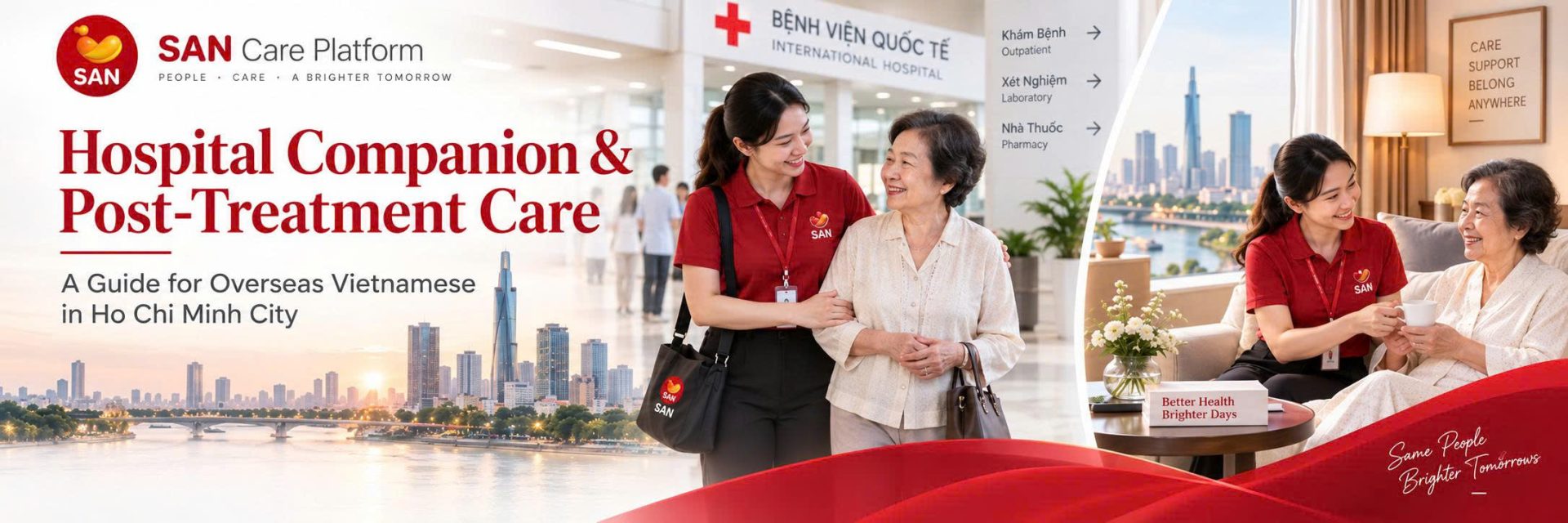
When people plan medical treatment in Ho Chi Minh City, most attention naturally goes to the hospital.
- Which doctor?
- Which department?
- What tests are required?
- How long will treatment take?
But for older adults, people recovering from illness or overseas Vietnamese travelling without close family nearby, another part of the journey matters just as much:
Who will help with everything around the medical appointment?
This is where hospital companion and post-treatment care can help bridge the gap between medical treatment and everyday life.
1. What is a hospital companion?
A hospital companion provides practical, non-medical assistance during the patient’s hospital journey.
Support may include:
- meeting the patient at home or accommodation;
- helping the patient prepare to leave;
- accompanying them to the hospital;
- helping with mobility;
- carrying documents or belongings;
- staying with them during waiting periods;
- helping them return home afterward.
The companion does not replace the doctor, nurse or hospital staff.
Medical decisions and clinical procedures remain the responsibility of healthcare professionals.
2. Who may benefit from a hospital companion?
This type of support may be particularly useful for:
Older overseas Vietnamese
A large hospital can involve significant walking, waiting and movement between departments.
Patients travelling alone
Someone may be comfortable managing their medical decisions but still prefer practical help during the day.
Patients with limited mobility
Walking from transportation to the consultation area or between departments may be difficult.
Families who cannot take time off work
Relatives in Vietnam may care deeply but may not be available during every appointment.
Families living overseas
Children may be in another country while their parent receives care in Ho Chi Minh City.
Having a local companion gives the patient practical assistance on the ground.
3. The hospital journey starts before arriving at the hospital
A medical appointment often begins much earlier than the scheduled consultation.
The patient may need to:
- wake up and prepare;
- organize documents;
- get dressed;
- travel through Ho Chi Minh City traffic;
- arrive at the correct entrance;
- move to the correct department.
For an elderly person, each small step can consume energy.
SAN has a guide covering this wider journey:
→ the journey from arrival and accommodation to the hospital
4. Do not forget the trip home
After the appointment, the patient may be:
- tired;
- hungry;
- uncomfortable;
- mentally exhausted from a long day;
- required to return for another visit soon.
Planning only transportation to the hospital leaves half the journey unresolved.
A companion can help the patient return to the place where they are staying and settle back into their routine.
5. Why post-treatment care matters
Not every patient needs hospital admission.
Some return home after:
- a consultation;
- diagnostic tests;
- a minor procedure;
- short treatment.
They may still need a period of rest and everyday assistance.
This does not necessarily mean medical nursing.
It may simply mean having someone available to help with:
- meals;
- personal hygiene;
- getting around;
- routine activities;
- preparing for the next appointment.
Read more:
→ when care may be useful after a medical appointment or short treatment
6. After hospital discharge
Discharge is an important milestone, but it does not always mean the patient has returned to full independence.
An older patient may still have difficulty:
- walking;
- bathing;
- preparing meals;
- managing everyday activities;
- attending follow-up appointments.
Families should carefully follow the discharge instructions provided by the hospital.
For practical home support, see:
→ care for patients at home after hospital discharge
7. Staying in a hotel, apartment or private home
Overseas Vietnamese may recover in different types of accommodation.
Wherever the patient stays, consider:
- ease of access;
- elevators or stairs;
- bathroom safety;
- distance from the hospital;
- who will be present during the day;
- whether the patient can safely manage daily activities alone.
For patients recovering in a private residence:
→ preparing care when staying at a private home in Vietnam
8. What happens when relatives are overseas?
Families living overseas often face a difficult balance.
They want to remain involved but cannot physically accompany every medical visit.
A practical arrangement is to establish:
- one primary family contact;
- one local contact if available;
- the patient’s schedule;
- care times;
- the information the family would like reported after the service.
This creates a clearer connection between:
Patient in Vietnam ↔ Local support ↔ Family overseas.
9. Hospital companion care and medical care are different
This distinction should always remain clear.
Cô SAN provides non-medical care and practical support.
SAN caregivers do not independently:
- diagnose illnesses;
- prescribe medication;
- change prescriptions;
- perform clinical procedures outside the permitted scope;
- make treatment decisions.
Patients and families should direct medical questions to qualified healthcare professionals.
10. A typical support journey may look like this
For example:
Before the appointment
Cô SAN arrives at the patient’s accommodation and assists with preparation.
Going to the hospital
The patient receives practical mobility and accompaniment support.
At the hospital
Cô SAN stays with the patient within the agreed service scope.
After the appointment
The patient is accompanied back to their accommodation.
Recovery
Care may continue at home if needed.
Follow-up
A companion can be arranged again for another hospital visit.
This creates continuity across the patient’s journey rather than forcing the family to find a new solution at every stage.
Arrange care before the hospital visit
If the hospital appointment is already scheduled, the family can contact SAN in advance.
Prepare:
- date and time;
- patient location;
- hospital name;
- mobility needs;
- expected duration;
- primary contact person.
See also:
→ book a SAN caregiver before travelling to Vietnam
and:
→ SAN services for overseas Vietnamese returning for healthcare
Need someone to accompany you or your parent to a hospital in Ho Chi Minh City?
📲 Download the SAN app to arrange caregiving or hospital companion support.
For first-time or more complex requests, contact the hotline so the SAN team can understand the situation before the service is arranged.
SAN – Where compassion is at the heart of every service.


