
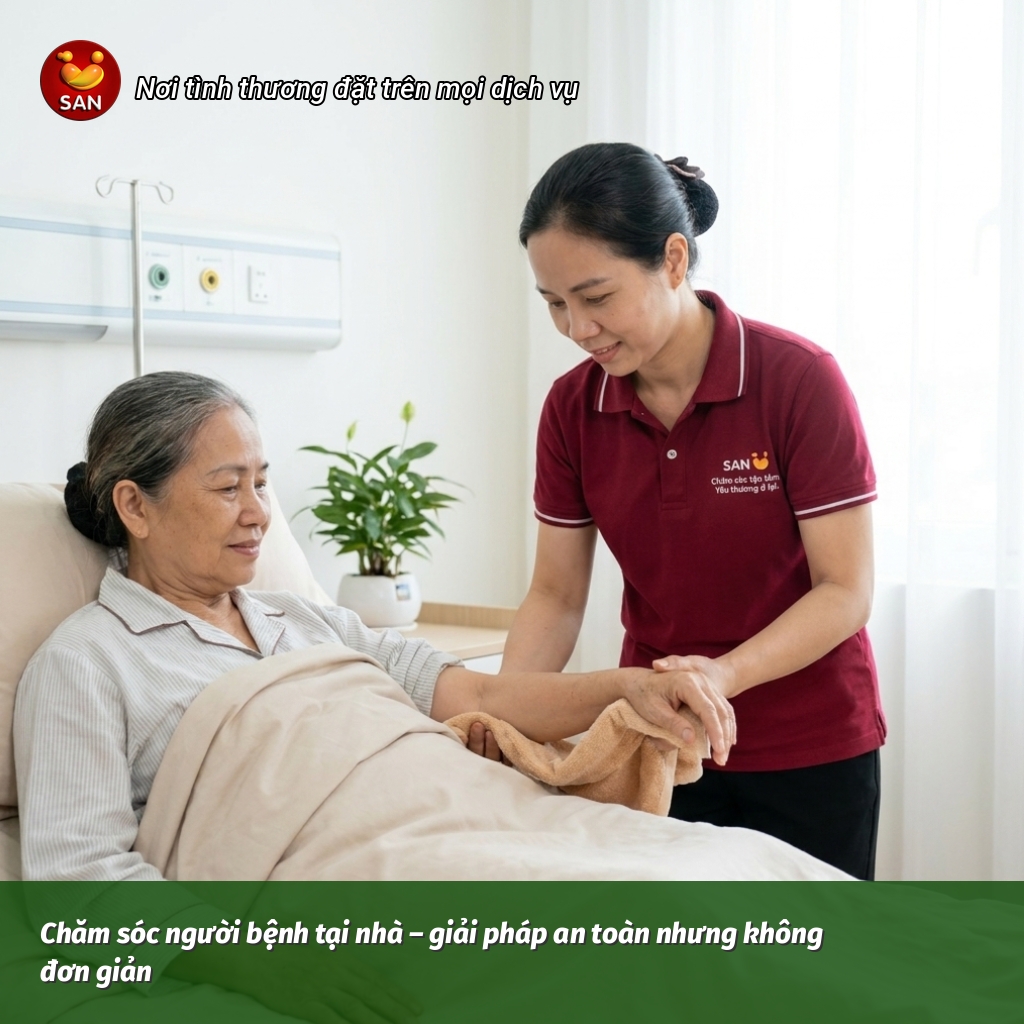
Home care for the sick – a safe but not simple solution.
In recent years, more and more families have been choosing this option. home care for the sick. Instead of leaving loved ones in the hospital or transferring them to a care center.
The reason is easy to understand.
At home, patients feel more comfortable. The familiar environment helps them eat, sleep, and maintain a stable mental state. Families also feel more at ease being close to their loved ones.
But it is precisely because of this sense of "familiarity" that many people underestimate the complexity of the process. home care.
Home care is not about "bringing the patient home and looking after them."
It's a process that requires coordination between health monitoring, mobility support, nutrition, and handling unforeseen situations. Without the right skills, home care can become a risk rather than a solution.
One of the most common mistakes is thinking that simply having someone by your side is enough.
In fact, caregivers need to know how to observe even the smallest changes in the patient. They need to understand when signs are normal and when they indicate the need for intervention. They need to know how to provide support without making the patient completely dependent.
If done incorrectly, problems such as ulcers, muscle stiffness, and declining health or mental well-being can develop without the family realizing it in time.
This is also why in many cases, "the more you try, the more tired you get" – not because of a lack of effort, but because of a lack of the right approach.
In what situations is home care most appropriate for patients?
- First of all patients after being discharged from the hospital However, monitoring and support are still needed. This is a critical stage, as the patient is not yet completely stable but does not need to stay in the hospital.
- Secondly frail elderly peopleThese individuals require assistance with daily living activities. Hospitalization is not necessarily required, but regular care is necessary.
- Thirdly, there are patients with chronic illnesses who require long-term care. Staying at home helps them maintain a better quality of life compared to a hospital environment.
In all these cases, the common point is: We need a skilled caregiver..
This is the major difference between hiring informally and using professional services.
Many families still choose "experienced caregivers" because they are easier to find and less expensive. However, as analyzed in the article about "experienced caregivers," care based on experience alone cannot handle complex situations.
The problem isn't that caregivers aren't dedicated, but that they aren't equipped to do it right.
In SAN care platform at home, each caregiver They all received training through SAN Care Academy Before starting work, this helps ensure that the caregiver not only knows how to do the job, but also understands what they are doing.
Besides, caregiver Don't work alone.
They have a support system behind them, someone they can call upon when faced with difficulties, and someone who can be replaced when needed. This helps prevent the family from becoming completely dependent on a single individual.
Another major advantage of home care is flexibility.
Families can choose the appropriate timeframe: hourly care, shift care, or long-term care. This helps optimize costs and suits individual circumstances.
But whichever method you choose, the most important thing is... quality of caregivers.
Home care is only truly a solution when done correctly.
If you're considering bringing a family member home to care for them, take the time to prepare properly – from understanding their needs to choosing the right caregiver.
Making the right decision from the start can help patients recover better and make the journey much easier for their families.
Contact SAN To receive advice on the most suitable home care services for your family's situation.


