
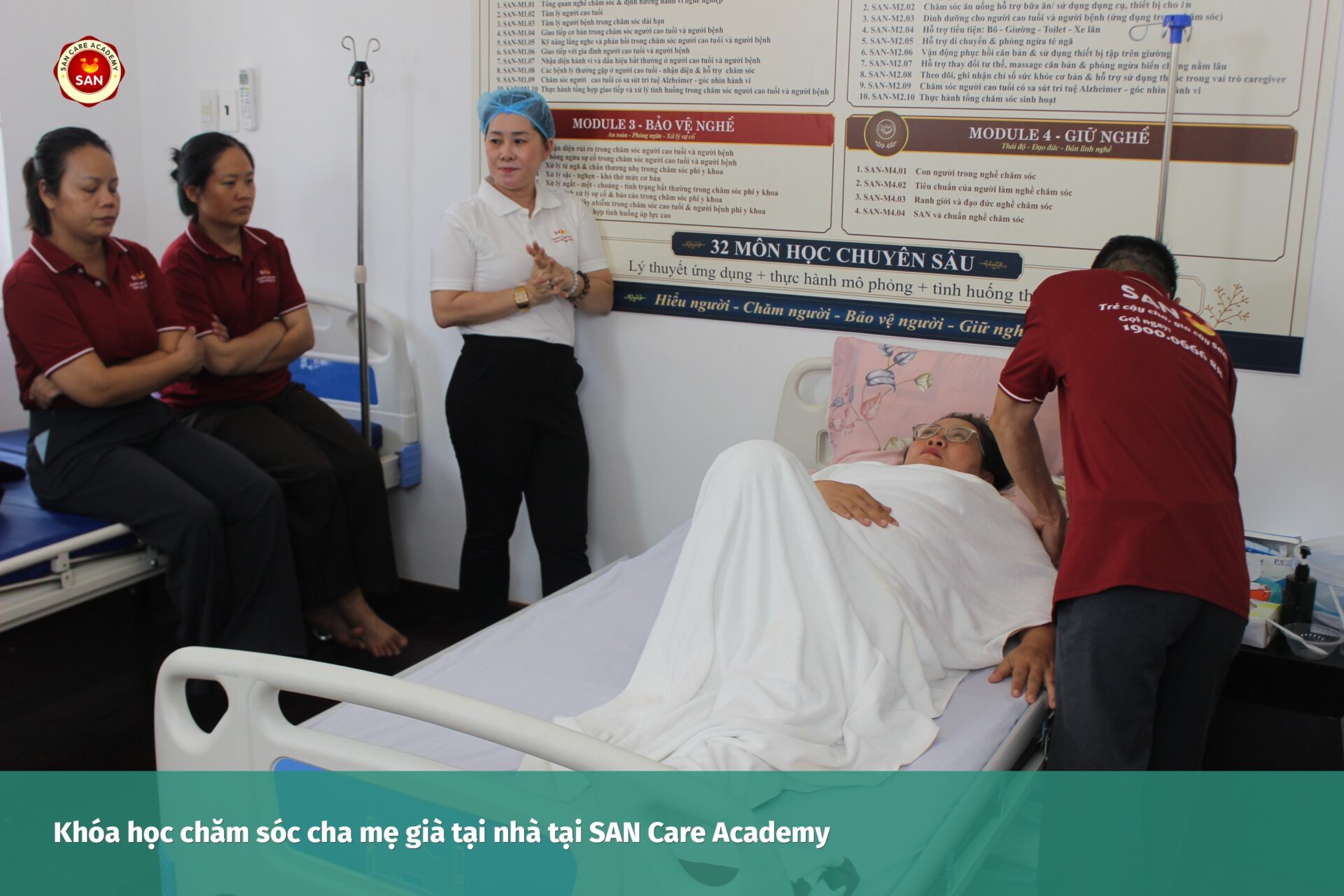
SAN Care Academy's course on caring for elderly parents at home.
Caring for elderly parents is a very loving but also very difficult task. There are times when we love our parents so much, but don't know how to care for them properly. There are times when we want to help them with eating, walking, bathing, and dressing, but are afraid of hurting them, afraid of them falling, or afraid of saying something insensitive that might upset them.
As parents begin to age, roles within the family gradually shift. Before, parents cared for their children. Now, children care for their parents. This reversal requires not only love, but also understanding, skills, and composure.
SAN Care Academy's course on caring for elderly parents at home.
Course on caring for elderly parents at home SAN Care Academy It was built for the children, grandchildren, and relatives of the family who wanted it. Learn how to care for the elderly. It's more accurate, safer, and less hurtful for parents.
This is not just a skills course. This is a way for families to care for their elderly parents with understanding and love.
Why should children learn how to care for their elderly parents?
Many people think that taking care of elderly parents is a natural family duty that doesn't require learning. They believe that if you love your parents, you'll naturally know how to care for them.
But in reality, Love alone is not enough..
Elderly parents may have weak legs, be prone to falls, have difficulty eating, sleep poorly, be forgetful, irritable, or easily saddened. Sometimes they may not want to bathe, eat, take medicine, go for checkups, or ask their children and grandchildren for help.
If children don't understand the psychology of the elderly, they can easily become impatient, pressure their parents, or say things that hurt their feelings. Without basic caregiving skills, families may unintentionally cause their parents to fall, choke, suffer pain, develop skin ulcers, or feel humiliated by their dependence.
Learn how to care for elderly parents. It's not because I lack love for my parents. On the contrary, it's precisely because I love them that I need to learn how to care for them better.
Taking care of elderly parents is not just an act of filial piety.
Filial piety isn't just about buying medicine, giving money, hiring caregivers, or being there for your parents. It's also about how you talk to them, how you help them stand up, how you ask if they're in pain, how you maintain discretion when assisting with hygiene, and how you make them feel respected.
There are children who love their parents very much, but because they worry so much, they often scold them: "Why do you always go out alone, Mom?", "You never listen to Dad," "Eat faster, Mom," "How could you forget something like that?"
Those words might stem from anxiety, but for the elderly, they can become a feeling of uselessness, being a burden, or that their children no longer have patience with them.
SAN Care Academy This helps families understand that caring for elderly parents requires not only love and compassion but also skill and sensitivity. Proper care ensures the safety of parents while also alleviating their feelings of loneliness and sadness.
Who is the home-based elderly care course suitable for?
This course is suitable for those who are directly caring for their parents, grandparents, or elderly relatives at home.
The course is also suitable for families where parents are becoming frail, have difficulty walking, are forgetful, have trouble eating, need assistance with hygiene, need fall prevention, or require more frequent care than before.
Parents who are confused about whether to care for their children themselves, hire a caregiver, or combine both can also participate to gain a better understanding. How to care for the elderly at home.
Additionally, the course is suitable for families who employ caregivers but want to learn how to monitor, coordinate, evaluate, and communicate with them more effectively.
What will the students learn?
Understanding the psychology of parents as they age.
As they age, parents not only become physically weaker. They may also become sadder, more sensitive, more easily offended, and more afraid of becoming a burden to their children and grandchildren.
Some parents don't want to ask their children for help because they're afraid of bothering them. Some parents are irritable because of pain, fatigue, or a loss of control over their bodies. Some parents repeat a sentence many times because their memory is declining. Some parents refuse to bathe, eat, or go to the doctor because they're afraid of losing their autonomy.
Once children and grandchildren understand this mindset, they will be less likely to blame or get angry, and will know how to speak more gently.
Caring for elderly parents is not just about caring for their physical well-being. It's also about caring for their self-esteem.
Ways to communicate to help parents feel less hurt.
Elderly people are very vulnerable to the tone of voice, attitude, and choice of words of their children and grandchildren.
A gentle word can reassure parents. A hasty remark can upset them all day.
The course guides families on how to communicate with elderly parents respectfully: speaking slowly and clearly, avoiding commands, shouting, or reproachful language, and refraining from discussing embarrassing topics in front of others.
Instead of saying, "I keep telling you to help, but you never listen," you could say, "Mom, let me help you, it'll be safer."
Instead of saying, "Dad, you're eating too slowly," you could say, "Dad, take your time eating. I'll sit here with you."
Small changes in language can make the caregiving atmosphere much gentler.
Support for safe eating
Older adults may eat slowly, chew weakly, have difficulty swallowing, be prone to choking, or eat less than before.
Families need to know how to support safer mealtimes: have parents sit in a proper position, avoid rushing them to eat, and observe them if they cough, choke, are tired, or show signs of difficulty swallowing.
Children and grandchildren also need to understand that eating is not just about "eating enough." For the elderly, meals are also about feeling cared for, being looked after, and being respected.
A safe meal is one that is not rushed, not forced, and does not make the elderly feel like they are being a nuisance.
Support personal hygiene with respect.
When elderly parents need their children and grandchildren to help with bathing, changing clothes, changing diapers, or personal hygiene, this is a very sensitive time.
Parents may feel embarrassed, ashamed, or sad because they can no longer do even the most private things themselves. If their children or grandchildren rush through the task, complain, or act without discretion, parents can easily feel hurt.
This course helps families understand how to support their parents' personal hygiene in a way that is clean, safe, discreet, and dignified.
Before starting, speak gently to let your parents know what you're about to help with. While doing so, maintain discretion. Afterwards, avoid showing annoyance or repeatedly bringing it up as if it were a burden.
Proper care is not just about keeping the body clean, but also about making parents feel respected.
Assisting parents with mobility and preventing falls.
Falls are one of the biggest risks for older adults.
A fall can cause parents pain, broken bones, prolonged bed rest, loss of self-confidence, or increased dependence on others. Therefore, families need to learn how to prevent falls by doing small things around the house.
The course guides families on paying attention to walkways, restrooms, stairs, lighting, slippers, slippery carpets, obstructions, and how to help parents stand up, sit down, and move around more safely.
Fall prevention isn't about forbidding parents from doing everything. Fall prevention is about creating conditions that allow parents to still exercise within their capabilities, but in a safer way.
Prevent choking while eating and drinking.
Elderly people, especially those who are frail, have recently suffered a stroke, or have difficulty swallowing, may be more prone to choking while eating and drinking.
Family members need to observe their parents while they eat: are they coughing a lot, choking, tired, having difficulty swallowing, or frequently gagging?
If any unusual symptoms appear, families should not be complacent or try to treat the condition themselves based on anecdotal evidence. They should seek advice from appropriate healthcare professionals for safer guidance.
Within the context of home care, it is important to feed parents slowly, in the correct posture, without forcing them to eat, and to always observe them closely.
Recognize the signs that require you to call a doctor or healthcare professional.
Family members don't need to turn themselves into doctors. But when caring for elderly parents at home, children and grandchildren need to know which signs shouldn't be ignored.
For example, parents may suddenly become more tired than usual, have difficulty breathing, fever, severe pain, falls, prolonged poor appetite, lethargy, altered consciousness, frequent coughing or choking, abnormal bowel or bladder function, or unusual wounds, red skin, or ulcers.
The course helps families understand the principles: do not self-diagnose, do not change medication without consulting a doctor, and do not attempt to treat conditions beyond your knowledge. When abnormal symptoms appear, report them to a caregiver, doctor, or appropriate healthcare professional.
Coordinate with hired caregivers.
Many families are unable to care for their parents full-time themselves, so they need to hire caregivers.
Even then, children and grandchildren should still understand basic caregiving principles so they know how to cooperate, communicate, and monitor the caregiver's work.
Families need to know what to ask, what to observe, what reports to request, and what signs indicate that the caregiver is working diligently, as well as signs that require reminders or changes.
SAN Care Academy Help families understand that hiring a caregiver doesn't mean complete detachment. Families still need to be involved, cooperate, and play a protective role for their parents.
How is this course different from a vocational caregiving course?
The home-based elderly care course has a different focus than the other course. elderly care profession.
Vocational training courses focus on equipping learners with the skills, ethics, and career orientation needed to perform professional caregiving tasks effectively.
Meanwhile, courses on caring for elderly parents at home focus more on family needs: understanding parents, providing proper care in daily life, preventing risks at home, communicating to alleviate parental loneliness, and knowing when to seek professional support.
If you want to learn a trade, SAN Care Academy can provide advice elderly care course or provide more appropriate care for the patient.
If you want to learn how to care for your parents, grandparents, or relatives at home, this course is a more practical and accessible option.
Learning pathway at SAN Care Academy
Step 1: Family situation counseling
Before studying, SAN Understand the family's needs: whether the parents are healthy, frail, recovering from a stroke, bedridden, have mobility issues, are forgetful, need assistance with hygiene, or simply require preventative care.
The counseling helps families choose appropriate learning content, avoiding overly broad courses that don't meet their needs.
Step 2: Learn the basics about older adults.
Families receive basic education on the psychology of the elderly, changes in daily routines, common risks, and communication skills to help parents feel less lonely.
Step 3: Learn home care skills
Families are instructed in practical caregiving skills such as assisting with feeding, hygiene, mobility, fall prevention, choking prevention, home safety, and observing for unusual signs.
Step 4: Practice the scenario.
Learners are exposed to common family situations: parents refusing to eat, refusing to bathe, being irritable, minor falls, choking while eating, not wanting to see a doctor, or being hesitant to seek help with hygiene.
Practicing scenarios helps families learn how to react more calmly instead of relying solely on emotions.
Step 5: Advise on the next steps in care.
After the course, SAN can provide further advice on suitable care options: family-based care, hiring a caregiver, or a combination of family members and caregivers. caregiveror may require additional professional support in some cases.
What will the family receive after completing the course?
After the course, families will gain a better understanding of the psychology of elderly parents, know how to communicate more gently, know how to support basic activities more safely, and know how to prevent many common risks at home.
The family will also understand what they can do themselves, what they need to ask healthcare professionals about, and what signs should not be ignored.
More importantly, the course helps children care for their parents with love and skills, so that filial piety does not inadvertently become a burden for both sides.
Why choose SAN Care Academy?
SAN Care Academy It is built upon the practical experience of caring for the elderly and the sick at home within the SAN ecosystem.
SAN understands that every family has different circumstances. Some families have children nearby but are busy. Some families have children who live far away. Some families have parents who are still healthy but are starting to get weaker. Some families have parents who have suffered a stroke, are bedridden for extended periods, or require almost full-time care.
Therefore, the course doesn't focus on abstract theory, but rather on very real-life situations in caring for elderly parents at home.
SAN Care Academy It helps families learn how to care for their children properly, safely, and while maintaining a warm parent-child relationship.
Frequently Asked Questions about the Home Care Course for Elderly Parents
Is this course suitable for people who are not working in the caregiving profession?
Yes. The course is designed for children and family members who want to learn how to care for their parents, grandparents, or elderly relatives at home.
I have no experience in childcare; can I learn?
Yes. The content is designed to be easy to understand, practical, and suitable for beginners.
Does the course teach diaper changing, hygiene, and mobility assistance?
Yes. Depending on the course requirements, students may be instructed in basic skills such as hygiene assistance, dressing, mobility assistance, fall prevention, and daily living care.
Does the course teach how to care for stroke victims?
Basic information on stroke care can be provided within the family setting. If the family needs more in-depth learning, SAN can advise on a more suitable stroke care course.
After graduating, will I be able to take care of my parents completely on my own?
The course helps families provide better and safer care in daily life. However, for medical issues, families should still consult a doctor or appropriate healthcare professional.
Is it possible to learn how to manage outsourced caregivers?
Yes. The course helps families understand basic care principles, enabling them to better coordinate, request reports, and monitor the quality of care.
Is this course suitable for busy people?
Depending on the course schedule, SAN can advise on a suitable learning path for working professionals, busy individuals, or families who need to focus on key content.
Is it necessary for the whole family to study together?
If possible, it's better for multiple family members to learn together, as everyone will have a shared understanding and can coordinate to provide more consistent care for their parents.
Register for a consultation on home care courses for elderly parents.
If you are caring for elderly parents at home and want to provide better, safer, and gentler care, SAN Care Academy We can advise on a course that suits your family's situation.
You can register to receive a consultation:
- The course is suitable for parents' situations.
- Latest tuition fees and class schedules
- Skills to be learned
- How to coordinate care within the family.
- Suggestions for hiring a caregiver when needed.
Sign up for a consultation today to learn how to care for your elderly parents at home with understanding, safety, and respect.
You love your parents but don't know how to take care of them properly?
Let SAN Care Academy advise you on the right course to help your family care for your elderly parents more safely, gently, and with less emotional distress for them.


