
"The Flower-Clad Nurse" and the Truth Behind a Misunderstood Profession
If you've ever had a loved one who needed care, you've likely heard the phrase "floral print nurse"
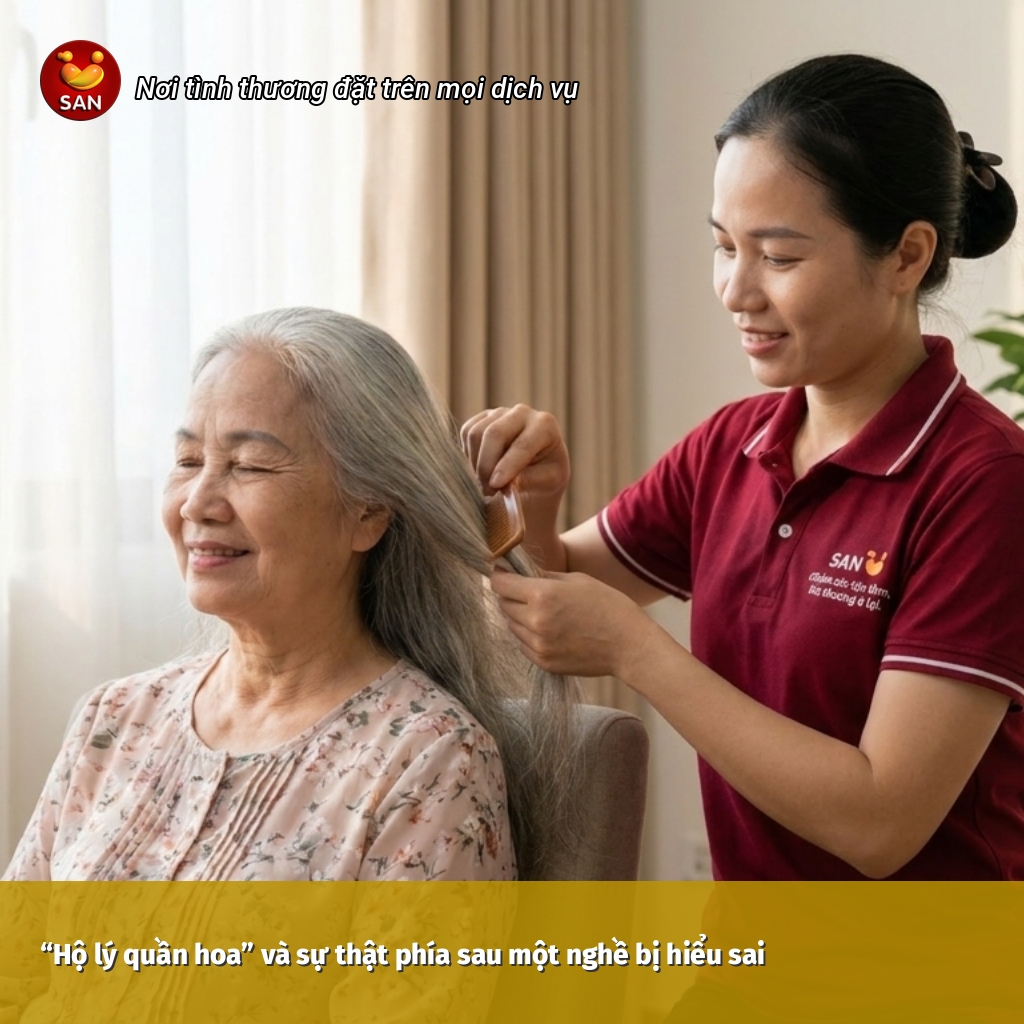
This is a common way of referring to those caregivers for the sick and the elderly. spontaneously.
They often come from acquaintances, relatives, or are referred by hospitals. There are no clear contracts, no formal training, yet they account for a very large share of the market. take care of Currently.
It is worth noting that:
They are not the problem. They are the consequence of a larger problem.
For many years, the demand caring for the elderly and the sick The number is increasing rapidly. But the formal training system hasn't kept pace.
That gap forced the market to "fill" itself with temporary solutions.
And "floral print nurse" is one of those solutions.
Many people who do this job are very dedicated. They care for others with experience, with practiced hands, and sometimes with genuine affection.
But the problem isn't about dedication. It's about the method.
When providing care without a foundation of knowledge, everything relies on habit. And habits aren't always right.
This leads to the following fact:
The quality of care is inconsistent.
Some people do well. Some people do wrong. And for the most part, there are no clear standards for evaluation.
This is also why many families are starting to ask questions:
Is there a more systematic way to do it?
As mentioned in the article, when a current job no longer provides a living wage, or when an industry has real demand but is not well-organized, it is often a sign of an opportunity.
The healthcare industry is currently in that very stage.
The need exists. But the system is not yet complete.
And as the market begins to change, the distinction between "temporary work" and "professional work" will become clearer than ever.
A properly trained caregiver will approach the job very differently.
Don't act on impulse. Don't handle things out of habit.
But it should be done according to principles, with observation, adjustment, and clear limits.
This not only helps keep those being cared for safer, but also contributes to the long-term development of those working in the field.
Meanwhile, the "flower girl nurse" model typically lacks a clear development roadmap.
You could take longer, but that doesn't guarantee you'll do a better job.
And income is often limited by that very method.
As will be analyzed in more detail in the article "A quiet profession that never runs out of work," when a job is elevated to a profession, its value also changes.
This is the shift the care industry is undergoing: from a “temporary solution” to a “real profession.”
And to enter that phase, the most important factor is not having more people doing the work, but having more people receiving the right training.
At SAN training institute, the model is built to address precisely this gap.
It's not just about teaching knowledge, but creating a clear roadmap from learning → practice → working within the SAN platform for healthcare.
This helps transform a seemingly "spontaneous" job into a career with potential for growth.
Returning to the original question: Is the phrase "Nurse in a floral dress" incorrect?
The answer is: no.
But that's not the destination. It's the starting point of an unfinished industry.
And as the industry gradually reorganizes, there will be clearer pathways for both those working in the profession and the families they need to care for.
If you want to better understand the difference between following experience and following a system, you can learn more about the roadmap. occupations in the care industry in SAN Training Academy.


