
Learn senior care for beginners at SAN Care Academy.
Many people want learn a trade in elderly care But they hesitate because they think they lack experience, have never worked in a healthcare environment, and are unsure if they can learn the skills or if they will be able to find a job after graduation.
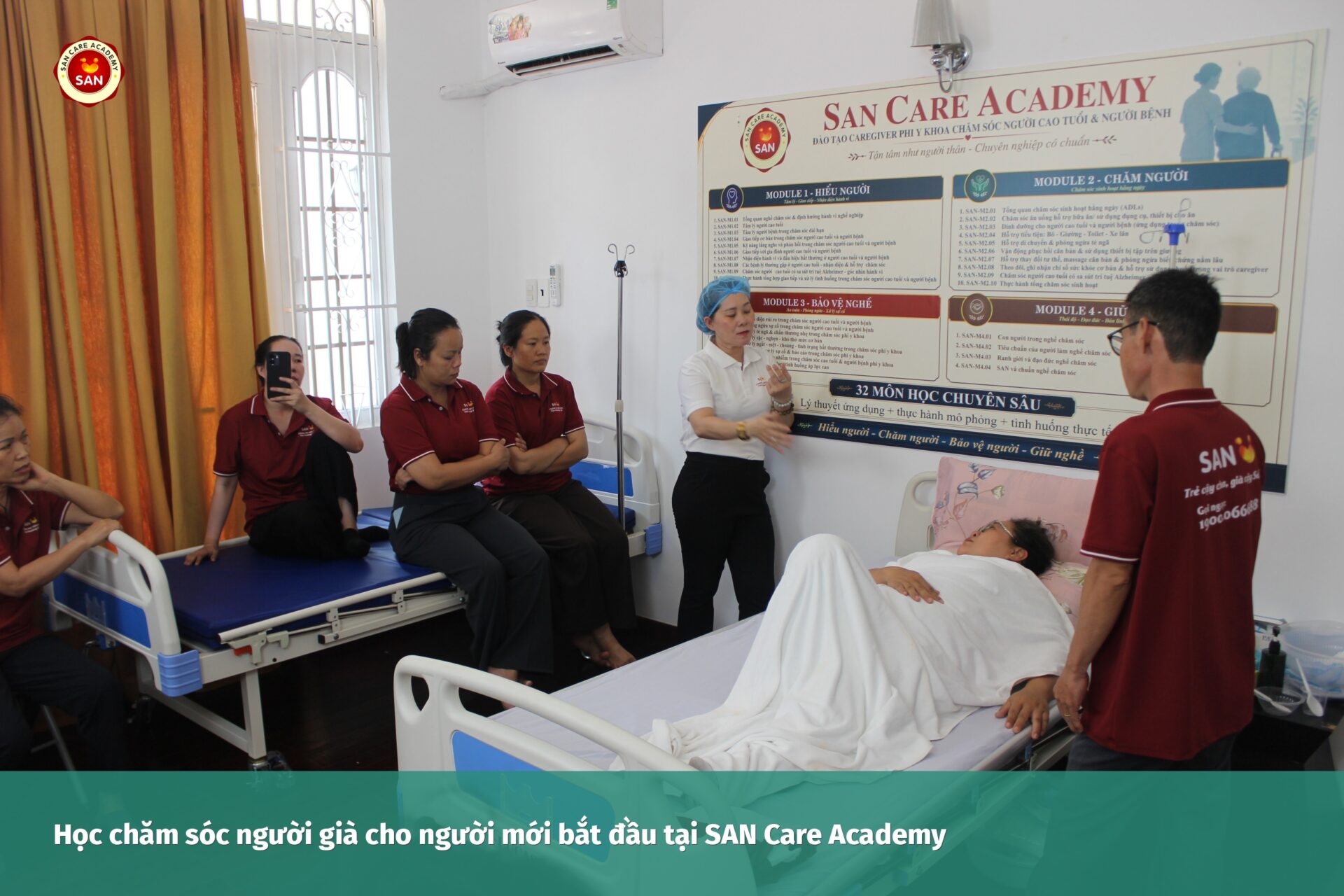
In reality, not everyone who starts a caregiving career has prior experience. Some have worked as domestic helpers and want to transition to a more formal caregiving career. Some are looking for a stable, meaningful job. Some middle-aged people want to learn a profession that suits them. And some simply want to care for their elderly parents in a more appropriate way.
Course Elderly care for beginners in SAN Care Academy It is designed to help students progress from the most fundamental knowledge to practicing basic caregiving skills, gradually understanding the profession, honing their skills, and determining whether they are suited to a career in caregiving.
Can beginners learn to care for the elderly?
The answer is yes, it's possible.
Even beginners with no experience can still do it. learn caring for the elderly If one possesses suitable health, patience, a kind attitude, and a serious commitment to learning the trade.
Occupation caring for the elderly It doesn't require learners to know everything from the start. But this profession requires learners to be willing to learn, accept corrections, listen to instructions, and understand that... elderly care It's not just manual labor.
A good caregiver needs to know how to help the elderly stand up, assist with eating, hygiene, dressing, prevent falls, communicate gently, observe for unusual signs, and report truthfully to the family.
These skills are entirely learnable if learners receive proper instruction and practice correctly.
Why should beginners learn systematically from the beginning?
New caregivers often tend to act on instinct. They rush to help the elderly if they see them weak. They urge them to eat slowly. They become upset or react negatively if the elderly are irritable. They assume that simply changing diapers, feeding, and wiping the patient's body is sufficient if the patient is lying down for a long time.
But in caregivingMany risks stem from very small things.
Incorrect support techniques can cause falls. Incorrect feeding posture can cause choking. Lack of privacy during hygiene practices can embarrass the elderly. Failure to observe the skin can lead to missed signs of ulcers. Failure to report problems promptly can leave family members unaware of the caregiver's condition.
Therefore, beginners should learn correctly from the beginning. Formal training helps trainees avoid bad habits, understand the limitations of the job, know how to provide safe care, and feel more confident when entering a real care environment.
Who is this course suitable for?
This course is suitable for those who have never worked in caregiving but want to start. apprentice caring for the elderly.
This course is also suitable for those who have previously worked as domestic helpers, caregivers for the sick, or caregivers for grandparents or parents but have not received formal training.
Middle-aged individuals seeking career stability, those looking to transition into the caregiving field, and those wishing to learn how to work in homes, nursing homes, care centers, or the SAN ecosystem can all explore this course.
Additionally, the course is also suitable for children and grandchildren who want to learn how to care for their elderly parents at home in a more proper, safer, and less awkward way.
What should beginners prepare before starting to learn?
Newcomers do not need prior medical experience. However, to learn... profession caring for the elderly Seriously, students should prepare a few things.
First of all suitable healthCaregiving jobs may require standing, walking, assisting the elderly with mobility, working in shifts, or handling many small tasks throughout the day.
Secondly patienceElderly people may be slow, forgetful, irritable, repetitive, uncooperative, or easily upset. If caregivers are impatient, the job will be very difficult to sustain.
Thirdly a kind and honest attitudeFamilies entrust their loved ones, property, and personal space to caregivers. Therefore, trustworthiness is a crucial factor.
Fourth is learning spiritBeginners don't need to be experts right away, but they need to be willing to learn the right way, practice diligently, and accept feedback.
What will the students learn?
Understanding the psychology of the elderly
The first lesson for a caregiver is not about manipulation, but about understanding the elderly.
Elderly people may be prone to sadness, easily hurt, and may repeat these feelings, fearing to bother their children and grandchildren, feeling uncomfortable being dependent on others, or not wanting others to care for them. If caregivers don't understand this, it's easy to think that the elderly person is deliberately making things difficult.
SAN Care Academy helps students understand that many behaviors in older adults stem from age, illness, fear of losing independence, and feelings of loneliness. By understanding this, caregivers can be calmer, speak more gently, and avoid taking the older adult's unpleasant remarks personally.
Daily living care skills
New caregivers will learn basic daily care skills such as assisting with eating, drinking, personal hygiene, changing clothes, changing diapers, assisting with mobility, arranging items around the elderly person, and observing their general condition.
These are seemingly simple tasks, but they need to be done correctly. Elderly care It's not about doing it as quickly as possible, but about doing it safely, cleanly, discreetly, and respectfully.
A good caregiver knows that every meal, every dressing change, every assistance with mobility is an opportunity to protect the elderly from risk and help them feel cared for.
Risk prevention skills
Elderly people thường dễ gặp rủi ro trong sinh hoạt như té ngã, sặc khi ăn uống, loét tì đè, mệt bất thường, đau nhức, mất ngủ hoặc thay đổi tâm trạng.
Newcomers need to learn to observe and take precautions from the small details. Is the toilet slippery? Are there any obstructions in the walkway? Does the elderly person have suitable slippers? Is their eating posture safe? Are there any unusual signs on the skin in pressure areas? Does the elderly person seem more tired than usual today?
SAN Care Academyy đào tạo học viên theo nguyên tắc: người chăm sóc không chờ sự cố xảy ra mới xử lý, mà cần biết phòng ngừa từ trước.
Communication skills with the elderly and their families.
Caregivers work not only with the elderly, but also with their families.
When caring for the elderly, caregivers need to speak slowly and clearly, without giving orders, shouting, showing annoyance, or making the elderly feel useless.
For the family, caregivers need to provide clear, honest, and timely reports. The family needs to know how the elderly person ate and slept that day, whether their mood was stable, if there were any unusual signs, and if there were any things to be aware of.
Good communication helps the elderly feel more secure, builds greater trust with their families, and enables caregivers to work more professionally.
Professional ethics in caregiving
Newcomers to the profession need to understand that caregiving involves entering the private space of a family home.
Caregivers can learn about what's going on in the house, see possessions, hear personal stories, and be with the elderly person when they are at their most vulnerable. Therefore, professional ethics It is an indispensable part.
Trainees are emphasized qualities such as honesty, punctuality, discretion, not taking or using family belongings without permission, not disclosing private matters, not speaking ill of those being cared for, and always reporting any problems that arise.
Kindness is necessary, but it must be accompanied by discipline and clarity.
Learning path for beginners
Step 1: Counseling on learning goals
Before starting a course, SAN provides counseling to understand whether students want to learn for employment, to care for family members, to change careers, or to upgrade their skills.
Each goal will require a different approach to counseling. Those learning for employment need a better understanding of job requirements, internships, and employment. Those learning to care for their parents need a greater focus on home care and family risk prevention.
Step 2: Learn the basics from scratch.
Newcomers learn the basics about the elderly, their psychology, daily living, safe care practices, and professional ethics.
This stage helps trainees understand that caregiving is not a temporary job, but a profession that requires high standards.
Step 3: Practice basic skills
Trainees practice common caregiving skills, from assisting with feeding, hygiene, dressing, and mobility to communication and reporting.
Practice helps beginners overcome fear and awkwardness, and better understand what they need to improve.
Step 4: Supervised Internship
For suitable students, after the initial foundational learning phase, SAN can guide them towards supervised internships.
This phase helps trainees become familiar with a real caregiving environment, develop professional skills, learn how to communicate with families, and may receive some financial support during their internship.
Step 5: Career Guidance
After the course, suitable participants may receive career guidance and advice in various environments. caring for the elderly at home, caring for the sick at home, nursing home, care center, or within SAN's ecosystem of care services.
Job opportunities depend on skills, attitude, health, academic performance, and the practical requirements of each position.
What can someone who has just finished their studies do?
After completing the course, students will be able to understand the fundamentals of the profession. caring for the elderlyThey will learn to assist with basic daily activities, communicate more appropriately, avoid common risks, and report to their family.
For students aiming for employment, this course is the first step towards further practice, internships, and skill development in a real-world environment.
For students learning to care for their loved ones, the course helps families feel less overwhelmed when caring for elderly parents, enabling them to do things correctly and avoid many common mistakes in home care.
Is it difficult to learn the trade of caring for the elderly?
Occupation caring for the elderly It's not a particularly difficult profession to start, but it's not easy either if you don't take it seriously.
The difficulty of the job lies not only in the procedures, but also in... patienceCaregivers must know how to remain calm when the elderly person is uncooperative, how to be gentle when the elderly person is irritable, how to be careful in every small task, and how to work honestly in the family environment.
With the right learning methods, consistent practice, and a positive attitude, beginners can absolutely gradually become familiar with the profession.
Why choose SAN Care Academy for beginners?
SAN Care Academy understands that newcomers often have many worries: fear of not being able to learn, fear of making mistakes, fear of not finding a job, fear of age not being suitable, fear of not feeling confident even after completing the course.
Therefore, the program is structured in a step-by-step, easy-to-understand, practical manner, with a strong emphasis on hands-on experience. Students not only learn caregiving skills but also how to understand the elderly, stay safe, communicate, and work responsibly.
SAN Care Academy benefits from SAN's real-world care ecosystem, so its training content is closely aligned with the practical needs of families and home caregiving tasks.
Studying at SAN is not just a short course; it's the first step for newcomers to the caregiving profession, enabling them to enter the field with greater confidence and professionalism.
Frequently Asked Questions about the Elderly Care Course for Beginners
I've never cared for the elderly before, can I still learn?
Yes. The course is designed for beginners. Students will be guided from fundamental knowledge to basic practical skills.
Is it possible to learn medicine without prior experience?
Yes. Trainees do not necessarily need a prior medical background. However, trainees need to have a clear understanding of the scope of non-medical care and avoid performing tasks beyond their area of expertise.
Can people aged 40-50 learn?
Yes, it's possible. Middle-aged people can still learn if they have the right health, patience, and a serious attitude towards the profession.
Can I start working immediately after graduating?
Employment depends on skills, attitude, health, academic performance, and the practical requirements of each position. For suitable students, SAN can guide them towards internships and employment after the course.
Does the course include practical exercises?
Yes. SAN Care Academy emphasizes practical experience because the caregiving profession requires real skills, not just theoretical knowledge.
Is an internship available?
For suitable students, after the initial foundational learning phase, SAN can guide them towards supervised internships to familiarize them with a real caregiving environment.
Will I receive a certificate upon completion of the course?
Depending on the program, students who complete the course may receive a certificate of completion. While the certificate demonstrates the learning process, practical skills and professional attitude remain crucial.
Is studying to care for elderly parents appropriate?
It's very suitable. The course helps children and grandchildren understand the psychology of the elderly, know how to support their daily activities, prevent risks, and care for their parents more effectively at home.
Register for a consultation on a beginner's course in senior care.
If you want to learn a trade caring for the elderly but I don't know where to start. SAN Care Academy We can advise you on a suitable plan based on your age, experience, health, and goals.
You can register to receive a consultation:
- This course is suitable for beginners.
- Latest tuition fees and class schedules
- Course duration and practical content
- Supervised internship conditions
- Job placement opportunities after the course.
Sign up for a consultation today to start your vocational training. caring for the elderly In a systematic, practical, and valuable way.
You have no experience but want to learn the trade. caring for the elderly?
Let SAN Care Academy advise you on the right path to start from the foundation, learn the right way, and gradually become familiar with the profession.


