
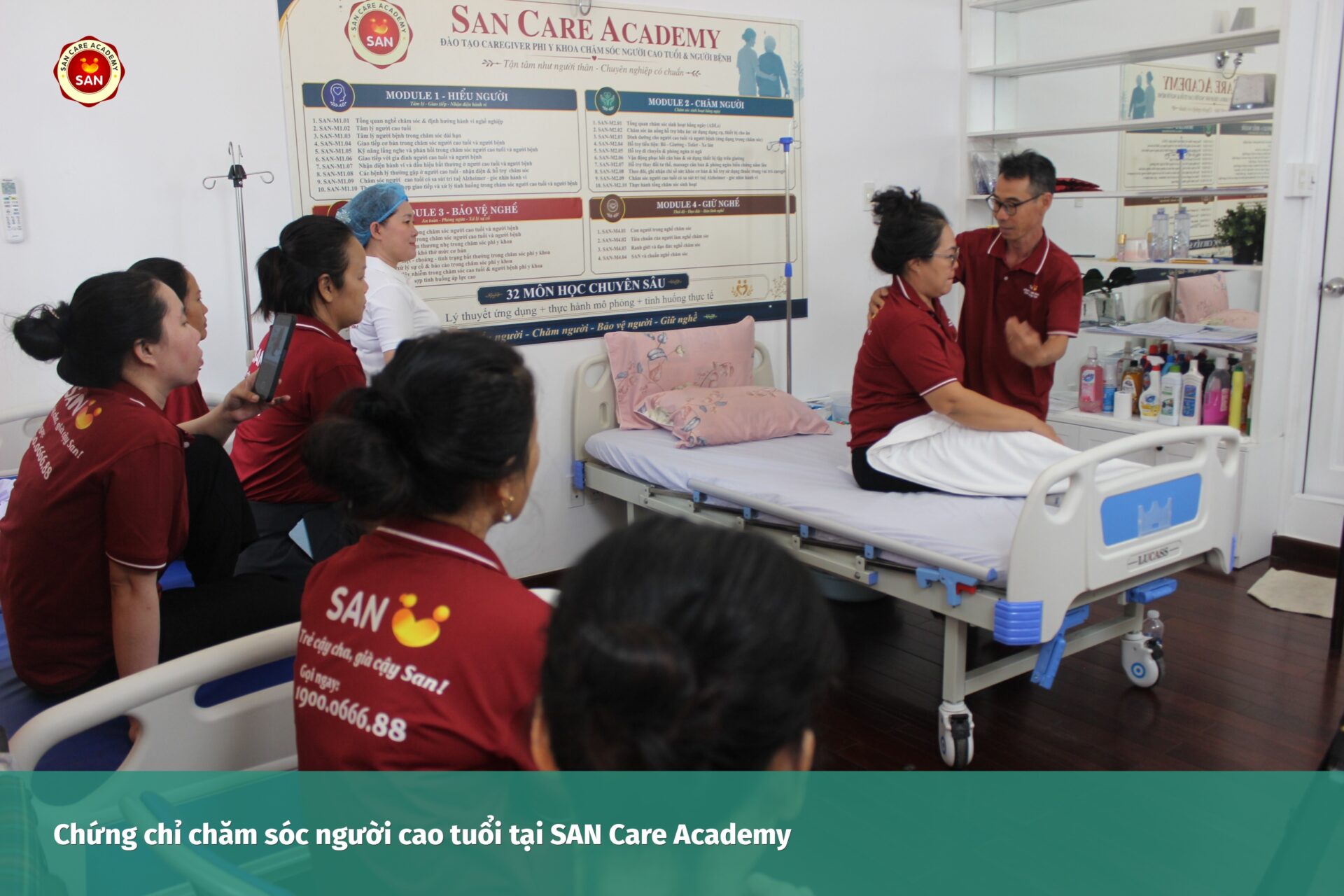
Certificate in aged care from SAN Care Academy
When researching the course caring for the elderlyMany students are interested in the question: will I receive a certificate upon completion of the course? Certificate in Elderly Care Can I get a job? Can I start working immediately after getting the certificate?
These are very practical questions. For those who want to... apprenticeA certificate or diploma of completion is an important part of the application. It shows that the applicant has participated in a training program, has been instructed in fundamental knowledge and skills, rather than simply practicing the profession based on personal experience.
However, SAN Care Academy I always emphasize one thing: certificates do not replace skills. If you want to work... elderly care profession In the long term, trainees need to possess real skills, the right attitude, professional ethics, and the ability to provide safe care in practice.
Why are so many people interested in aged care certification?
Learners are interested in certificates because they want a basis for proving that they have received training.
When applying for a job caring for the elderlyWhether they are caring for patients at home, working in nursing homes or care centers, or applying for positions in care services, trainees often want documentation demonstrating their educational background.
Families hiring caregivers are increasingly concerned about whether the caregiver has received basic training. They no longer just need someone who is "healthy" or "experienced," but someone who knows how to provide proper care, manage risks, communicate effectively, and report on their care.
Therefore, a certificate or diploma of completion can help students gain initial confidence. But to keep their jobs, perform well, and earn the long-term trust of their families, students still need practical skills.
Is a certificate the only requirement for getting a job?
Are not.
Certificates are part of a resume, but they are not the only factor determining whether a trainee will be successful in their profession.
In elderly care professionFamilies and employers often consider various factors: whether the trainee knows how to assist the elderly with eating, how to prevent falls, how to change diapers, provide hygiene, assist with mobility, how to observe for unusual signs, whether they are honest, punctual, and have gentle communication skills.
A person with a certificate but who is hot-tempered, dishonest, doesn't know how to report, or doesn't know how to protect family privacy will still find it very difficult to stay in the profession long-term.
Conversely, a trainee with a course completion certificate, good practical skills, a serious attitude, and clear professional ethics will have a better foundation to enter the caregiving profession.
So, SAN Care Academy The training approach emphasizes that while certification is the outcome of the learning process, it is skills and attitude that ultimately help trainees go far.
What is the significance of a course completion certificate?
A certificate of completion demonstrates that the student has participated in the training program. SAN Care Academy and have been instructed on the relevant matters. Caring for the elderly.
Depending on the specific program, the certification may demonstrate that the trainee has learned content such as geriatric psychology, daily living care skills, caregiving safety, communication with the elderly and their families, caregiving ethics, and the limitations of non-medical caregivers.
This certification may be part of the application when trainees apply for caregiving jobs. However, trainees should understand that each employer or family may have its own standards.
SAN Care Academy We discourage students from viewing certification as a "guaranteed job." Instead, certification should be understood as a milestone indicating that students have completed a learning phase and need to continue their training in practice.
What should a certified course teach?
One elderly care course A certified program shouldn't just teach a few simple tasks. If the goal is to provide students with a solid foundation for employment, the program needs to include knowledge, skills, attitude, and professional ethics.
Basic knowledge about the elderly
Students need to understand how older adults change in terms of health, emotions, daily routines, and psychology.
Elderly people may be forgetful, irritable, easily saddened, afraid of being dependent, afraid of bothering their children or grandchildren, or unwilling to admit that they are becoming frail. If caregivers don't understand this, they can easily become impatient or react incorrectly.
Understanding the elderly helps trainees provide care with more patience, respect, and less likely to upset them.
Daily living care skills
Trainees need to learn basic caregiving skills such as assisting with eating, personal hygiene, dressing, changing diapers, assisting with mobility, preparing a safe living space, and assisting the elderly with daily tasks.
These are very practical skills. Families need caregivers who can actually do the job, not just talk about the knowledge.
Every care procedure requires careful attention. Rushing isn't necessarily the best approach. Doing things correctly, safely, and respectfully is what truly matters.
Safety in care
Older adults are often more susceptible to risks such as falls, choking while eating, pressure ulcers, aches and pains, unusual fatigue, or changes in health.
Trainees need to learn preventative measures from small details: are there any obstructions in the walkway? Is the toilet slippery? Is the elderly sitting in the correct posture while eating? Are there any unusual signs on the skin? Is the elderly person more tired than usual today?
Good caregivers not only handle problems when they occur, but also know how to prevent them so that they happen less often.
Communication and reporting
Caregivers need to know how to communicate with the elderly and their families.
When speaking to the elderly, speak gently, without shouting, giving orders, or speaking in a reproachful tone. With family members, report clearly, honestly, and on time.
Families need to know how the elderly person is eating, sleeping, whether their mood is stable, if there are any unusual signs, and if there are any things to be aware of.
Reporting skills help caregivers build trust and work more professionally.
Professional ethics in caregiving
Professional ethics is an integral part of the training program.
Caregivers need to be honest, punctual, discreet, safeguard family property, respect privacy, refrain from disclosing personal matters, and not act beyond the scope of their instructions.
In the caregiving profession, skills enable trainees to perform their jobs. But professional ethics earn them trust.
SAN Care Academy focuses on hands-on learning and practical application.
SAN Care Academy Certification should not be considered the sole selling point of a course. What matters more is what students learn, what they can practice, and whether they have a proper understanding of the caregiving profession.
Program of SAN Care Academy The training is built upon the practical experience of caring for the elderly and sick at home within the SAN ecosystem. Therefore, the training content closely reflects situations that trainees may encounter in their work.
Students are taught not just to know, but to be able to perform basic tasks safely, discreetly, and responsibly.
SAN Care Academy The goal is for students to understand that caring for the elderly is not a job to be taken lightly. It requires kindness, but also standards, skills, and discipline.
Does a certificate in aged care help with job applications?
Certificate or certification of course completion This can give students an advantage when presenting their applications, especially beginners with little experience.
However, whether or not you get the job depends on many other factors such as practical skills, attitude, health, communication skills, honesty, suitability for the job, and actual recruitment needs.
SAN Care Academy SAN can provide guidance on suitable internships and job placements for students. However, SAN does not guarantee automatic employment based solely on a student's certification.
SAN aims to help students build a better career foundation, gain a deeper understanding of the profession, and be more prepared when they enter the real caregiving field.
Who should take a certified aged care course?
This course is suitable for those who want to learn elderly care to find employment, beginners with no experience, those who have cared for the sick but lack formal training, those who have worked as domestic helpers and want to transition to more professional caregiving, or those who want to enhance their educational background to apply for caregiving jobs.
The course is also suitable for middle-aged individuals seeking a practical career, those wishing to become caregivers, and those looking to work in homes, nursing homes, care centers, or within the SAN care services ecosystem.
Additionally, those learning to care for elderly parents at home can also participate if they wish to learn in a more structured way, even if their goal is not necessarily to pursue a career in the field.
Can someone with no experience learn this?
Have.
Even those who have never cared for the elderly before can learn if they are in good health, have patience, a serious attitude, and a desire to learn properly from the beginning.
SAN Care Academy guides students from the basics to practical application. Students don't need to know everything from the start, but they need to be ready to learn, correct mistakes, and hone their skills.
For beginners, a certificate of completion can help demonstrate a serious start. But after that, students still need to continue practicing and gaining experience.
Will I get an internship after graduation?
For suitable students, after the initial foundational learning phase, SAN can guide them towards supervised internships.
Internships help trainees become familiar with a real caregiving environment, hone their demeanor, practice communication with families, and gain a better understanding of the job requirements.
In some cases, eligible students may receive partial financial support during their internship. However, internships and financial support depend on the program, practical conditions, academic performance, and the student's suitability.
Internships are not an automatic job guarantee, but they are an important step in helping trainees hone their skills and increase their readiness for the workforce.
Why choose SAN Care Academy?
SAN Care Academy has an advantage because it is built within SAN's genuine care ecosystem.
This helps ensure that the training program is not just theoretical, but is connected to real-life situations involving the care of the elderly and the sick.
Trainees learn how to understand the elderly, provide care, prevent risks, report to their families, maintain professional ethics, and work with respect.
SAN Care Academy doesn't just help students obtain a certificate of completion. SAN wants students to have a solid foundation to work in the caregiving profession safely, reliably, and with value.
Frequently Asked Questions about Aged Care Certification
-
Will I receive a certificate in aged care after completing the course?
Depending on the program, students who complete the course may receive a confirmation or certificate of completion. Specific information will be provided by SAN Care Academy for each course.
-
Can a certificate in aged care be used to get a job?
Certificates or diplomas of course completion can support your application. However, job opportunities depend on your skills, attitude, health, experience, and actual hiring needs.
-
Does having a certificate guarantee a job?
That shouldn't be the case. Certification is just part of the academic record. To have a long-term career, trainees need real skills, professional ethics, communication skills, and suitability for the job.
-
Can someone with no experience learn this?
Yes. The course is suitable for beginners if the student is in good health, has a serious attitude, and the right mindset for learning the trade.
-
Does the course include practical exercises?
Yes. SAN Care Academy emphasizes practical experience because the caregiving profession requires real skills, not just theoretical knowledge.
-
Is there any internship guidance?
For suitable students, SAN can guide them towards supervised internships after the initial foundational learning phase.
-
Can a certificate from a course replace a medical degree?
No. A certificate of completion for a caregiving course does not replace a medical degree. Non-medical caregivers need to understand the scope of their work and not perform medical interventions outside their area of expertise.
-
Do I need a certificate to study how to care for elderly parents?
If the goal is to learn how to care for parents, certification isn't the most important thing. What matters is that the family learns how to care for them properly, safely, and respectfully.
Register for a consultation on a certified course in aged care.
If you are interested in learning aged care and are looking for a certificate of completion, SAN Care Academy We can advise you on a suitable program.
You can register to receive a consultation:
- Suitable courses in elderly care
- Learning and practice content
- Information regarding certificates/qualifications awarded after the course.
- Latest tuition fees and class schedules
- Supervised internship conditions
- Career guidance after the course
Register for a consultation today to learn comprehensive, hands-on elder care with clear career guidance.
Are you interested in learning aged care and need a certificate of completion?
Let SAN Care Academy advise you on a program that suits your learning, internship, and career goals.


