
Job placement assistance after completing the course at SAN Care Academy.
One of the biggest questions students ask when researching the course is: caring for the elderly or caring for the sick The question is: will I be able to find a job after graduating?
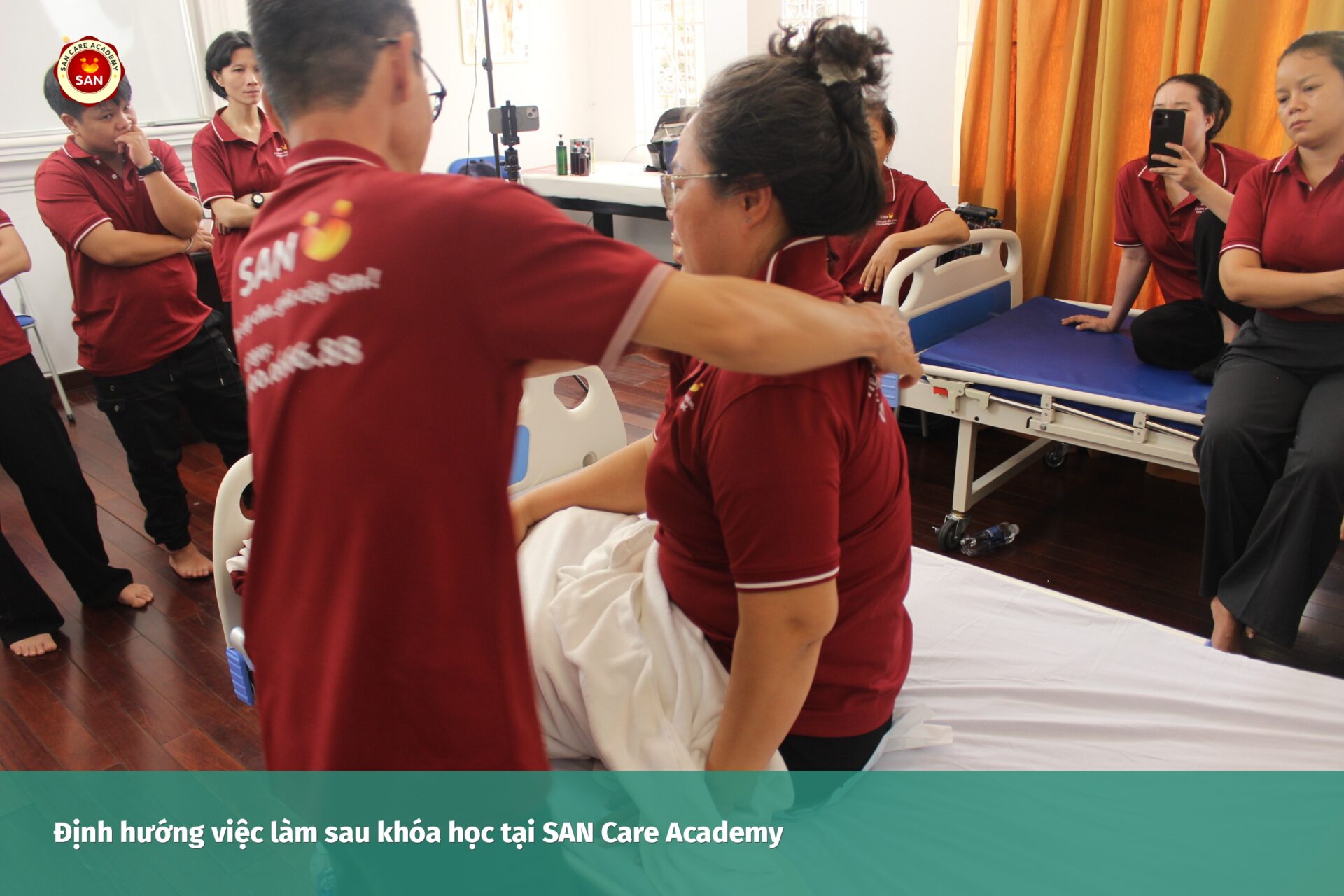
This is the question. very practicalLearners don't just want to gain more knowledge. Many need a profession, an income, more stable job opportunities, and a clear path to enter the caregiving field.
SAN Care Academy understand that training caregiving We can't just stop. Upon completing a training course, students need to understand the profession, practice their skills, develop professional conduct, understand professional ethics, and receive career guidance that matches their abilities, health, experience, and personal goals.
So, SAN Care Academy We build a practical learning path: foundational learning, skills practice, and for suitable students, we may guide them through supervised internships, followed by career counseling in the field. caring for the elderly and the sick..
What can you do after studying elder care?
After learning to care for the elderlyStudents can choose from a variety of job categories depending on their skills, health, experience, and suitability.
Students can do jobs providing home care for the elderly, support for the elderly In daily life, caring for the elderly and infirm, assisting older patients, caring for patients after strokes, caring for bedridden patients, or working in care environments such as nursing homes, senior care centers, care facilities, or SAN's care service ecosystem.
However, SAN Care Academy Students are discouraged from thinking that simply completing the course guarantees they can handle every caregiving task. Each caregiving job has different requirements. Some tasks only require basic assistance with daily living. Some require caring for frail patients. Some require experience with bedridden patients. Some require good health to assist with mobility.
Therefore, career guidance should be based on actual abilities, not just on the student's aspirations.
Common work environments after the course
Home care for the elderly
These are very common types of jobs in society today.
The caregiver can support for the elderly In daily activities such as eating, personal hygiene, changing clothes, moving around, talking, reminding each other of schedules, observing general conditions, and reporting to family.
Caring for the elderly at home requires patience, honesty, punctuality, and good communication with the family. Caregivers not only work with the elderly but also need to build trust with their children, grandchildren, and relatives.
Home care for the sick.
Patients at home may need more support than those who are not. elderly Still relatively healthy.
Caregivers can assist with eating, hygiene, dressing, diaper changes, sheet changes, mobility, position changes, monitoring for unusual symptoms, and reporting them to family.
This is a group of tasks that require a higher degree of caution, especially when the patient is weak, bedridden for extended periods, recovering from surgery, after a stroke, or has significant limitations in daily activities.
Non-medical caregivers need to clearly understand the limits of their work. They must not self-medicate, attempt to treat complex wounds, or perform any medical interventions without proper expertise and authorization.
Working at a nursing home or care center.
Some trainees may choose to work in nursing homes, senior care centers, or support care facilities.
This environment typically has clearer procedures, involves caring for more people simultaneously, and requires trainees to be able to work collaboratively in a team.
Working at a care facility helps trainees develop a professional demeanor, learn how to work according to procedures, report, hand over shifts, and follow the instructions of their supervisor.
Working within SAN's care ecosystem
For suitable trainees with a positive attitude, required skills, appropriate health, and satisfactory academic results, SAN may consider guiding them towards employment opportunities within SAN's care services ecosystem.
This is key advantage belong to SAN Care AcademyThis is because SAN not only provides theoretical training but also connects it to the practical care needs of families and the market.
However, job opportunities within the SAN ecosystem exist. Not an automatic commitment For all trainees. Trainees need to meet requirements regarding skills, professional ethics, work attitude, communication skills, and suitability for each position.
What do employers look for in caregivers?
Family or employer It's not enough to just have someone who has "taken a caregiving course."They need someone. competent, trustworthy, and well-behaved..
A good caregiver needs many qualities.
- First and foremost are basic caregiving skills. Caregivers need to know how to assist with eating, hygiene, mobility, dressing, diaper changes, positioning, observing for unusual signs, and preventing risks in daily life.
- Secondly, there's the attitude. Caregiving requires patience, calmness, kindness, and the ability to avoid taking the unpleasant words or behaviors of the elderly or sick personally.
- The third is honesty. Families entrust their loved ones, personal space, and possessions to caregivers. Therefore, honesty is essential. required qualities.
- Fourth is the ability to report. Caregivers need to know how to report concisely, clearly, truthfully, and promptly. If the elderly person falls, refuses to eat, shows unusual symptoms, or an incident occurs, the caregiver must... Report it immediately, without concealment or evasion..
- Fifth, know your career limits. Non-medical caregivers should not self-diagnose, self-medicate, or self-administer medical interventions. Knowing the limits is key. signs of professionalism.
Why does formal education increase job opportunities?
Many people can begin caring for the elderly based on personal experience. But to long-term employmentFormal learning will give students a better foundation.
Formal training helps students learn how to provide safer care, communicate more professionally, and avoid common mistakes.
A trained caregiver will understand that they shouldn't rush to help an elderly person, shouldn't force them to eat, shouldn't attempt to treat unusual symptoms on their own, shouldn't say things that upset the elderly, and shouldn't treat reporting as a secondary matter.
When trainees possess the necessary skills, the right attitude, and know how to follow procedures, families will feel more at ease. This is... important factor This helps students get jobs, keep jobs, and develop their careers long-term.
How does SAN Care Academy provide career guidance?
SAN Care Academy Training should not be just about completing the course and then ending it.For suitable students, SAN can provide career guidance after the course.
Orientation may include advising on suitable job groups, assessing trainees' readiness, suggesting internship pathways, providing guidance on workplace etiquette, reinforcing professional ethics principles, and connecting trainees with suitable opportunities if there is a real need.
SAN Care Academy also helps students understand that each person has different strengths. Some students are suited to caring for relatively healthy elderly people. Some are suited to caring for sick people at home. Some students need more training before taking on difficult cases. Some students should start with basic cases to gradually get used to them.
Proper career guidance will help students. Don't take on tasks that are beyond your capabilities, don't have unrealistic expectations, and don't enter a career without a clear direction..
Conditions for receiving career guidance
Not every graduate is immediately suited to every caregiving job. Therefore, SAN Care Academy needs to have... clear standards when considering career paths.
Trainees need to complete key coursework, participate diligently in practical sessions, maintain a positive attitude, be in suitable health, and understand the limitations of non-medical caregiving.
Trainees also need to demonstrate honesty, punctuality, good communication skills, the ability to report, the ability to maintain privacy, and respect for those being cared for.
For trainees who lack skills or are not yet ready, SAN can advise on supplemental training, additional practice, or starting with more suitable jobs before taking on challenging caregiving cases.
This method helps Protecting students, their families, and those under their care..
What kind of work should a new trainee start with?
For beginners, Don't rush into taking on overly difficult cases. If you don't have enough skills.
New trainees can start with basic living care tasks for elderly people who are relatively cooperative, assisting with eating, mobility, conversation, light hygiene, observation, and reporting.
With more experience, trainees can gradually become familiar with more challenging cases such as frail patients, bedridden patients, stroke patients, or those requiring more assistance with daily activities.
Go slowly but surely. This will help trainees retain their skills better. The caregiving profession. No need to rush.The important thing is the students. Do it right, do it safely, and maintain your family's trust..
Is the job of caring for the elderly a stable source of income?
Income in the profession of caring for the elderly and the sick. It depends on many factors. such as skills, experience, shifts, working hours, the degree of dependence of the person being cared for, and the personal reputation of the caregiver.
Beginners should have realistic expectationsThe first phase is apprenticeship, training, and practical training If you're a good fit and build trust, then with improved skills, a more confident demeanor, and greater family trust, job opportunities can also improve.
SAN Care Academy SAN should not promise overly attractive income levels to lure students. Instead, SAN guides students to understand that sustainable income comes from... Genuine competence, genuine attitude, and genuine professional reputation..
Does supervised internship help increase job opportunities?
Yes, if the trainee serious and demonstrate appropriateness with the profession.
Supervised internships help students become familiar with a truly caring environmentThis helps develop punctuality, learn how to communicate with family, handle real-life situations, and gain a better understanding of job requirements.
This is also the stage for SAN student evaluation: Is the trainee honest, careful, able to report, able to remain calm, and suitable for home care?
If trainees perform well during their internship, they will be better positioned for job opportunities. more realistic basis.
Is it a good idea to study aged care to find a job?
If you are looking for a Practical professions that are in demand by society. And if you are patient, careful, and kind, then caring for the elderly is a good career path. worth considering.
However, this This is not a job for those who want to do a sloppy job.The caregiver must know in charge of with people weaker than oneself, working in private space of the family, handle many small tasks every day and maintain a positive attitude even when faced with difficult situations.
If you are ready to learn the right skills, hone your abilities, and pursue your career with dedication, SAN Care Academy could be the place to help you begin this journey. more systematic.
Why choose SAN Care Academy?
SAN Care Academy has advantage because it was built from true care ecosystem of SAN. This helps the training program. linked to real needs of family and the care market, It's not just theoretical..
Trainees receive training in caregiving skills, safety, communication, professional ethics, and work conduct.
SAN understands that families are not just looking for someone who knows how to care, but someone trustworthy. Therefore, SAN Care Academy trains students in the following ways: Take care of things properly, report truthfully, behave kindly, protect property, maintain privacy, and practice your profession responsibly..
Frequently Asked Questions about Employment After the Course
- Will I be offered a job after graduation? SAN Care Academy can career guidance for suitable students. Job referrals or connections. It depends on skills, attitude, health, academic results, internship results (if any), and actual needs. of each position.
- Does SAN have a job guarantee? SAN Automatic job commitments should not be made. For all students. SAN Focus on practical training, internship orientation, and career counseling. for students who meet the requirements.
- Can someone who has just finished their studies start working immediately? It varies from student to student.Some people may start with basic tasks after being assessed as suitable. Others may need further practice or internships before starting a job.
- Can trainees work in the SAN ecosystem? Maybe, provided that trainees meet the requirements regarding skills, attitude, health, professional ethics, and the actual recruitment needs of SAN at each given time.
- After graduating, can I work at a nursing home? It is directional. Work at nursing homes or care centers if the trainee is suitable for the requirements of that environment.
- Is caring for the elderly a suitable profession for middle-aged people? It may be suitable if the learner has good health, patience, a serious attitude, and the ability to work steadily.
- Do men have opportunities in caregiving professions? HaveMen may be well-suited to many caregiving jobs, especially those requiring mobility assistance, shift work, or caring for patients who need to be in good health.
- What is the income for a job in elderly care? Income It depends on skills, experience, shift schedule, the level of dependence of the person being cared for, and personal credibility.SAN can more practical advice according to individual educational and career paths.
Register for career guidance consultation after the course.
If you want to learn elderly care or sick care to get a job, SAN Care Academy maybe advise on a suitable travel route. From foundational learning, practical training, supervised internships to career guidance.
Can you Register to receive a consultation.:
- This course is suitable for those aiming to get a job.
- Practical content to be learned
- Supervised internship conditions
- Job placement opportunities after the course.
- The program is tailored to your age, experience, and health.
Sign up for a consultation today! To begin vocational training in elderly and sick care, following a practical and clearly defined curriculum.
You want to learn childcare but are worried about finding a job after graduation?
Let SAN Care Academy advise you on a suitable learning, practice, internship, and career path.


