
Medical Treatment in Vietnam for Overseas Vietnamese: What to Prepare Before You Travel
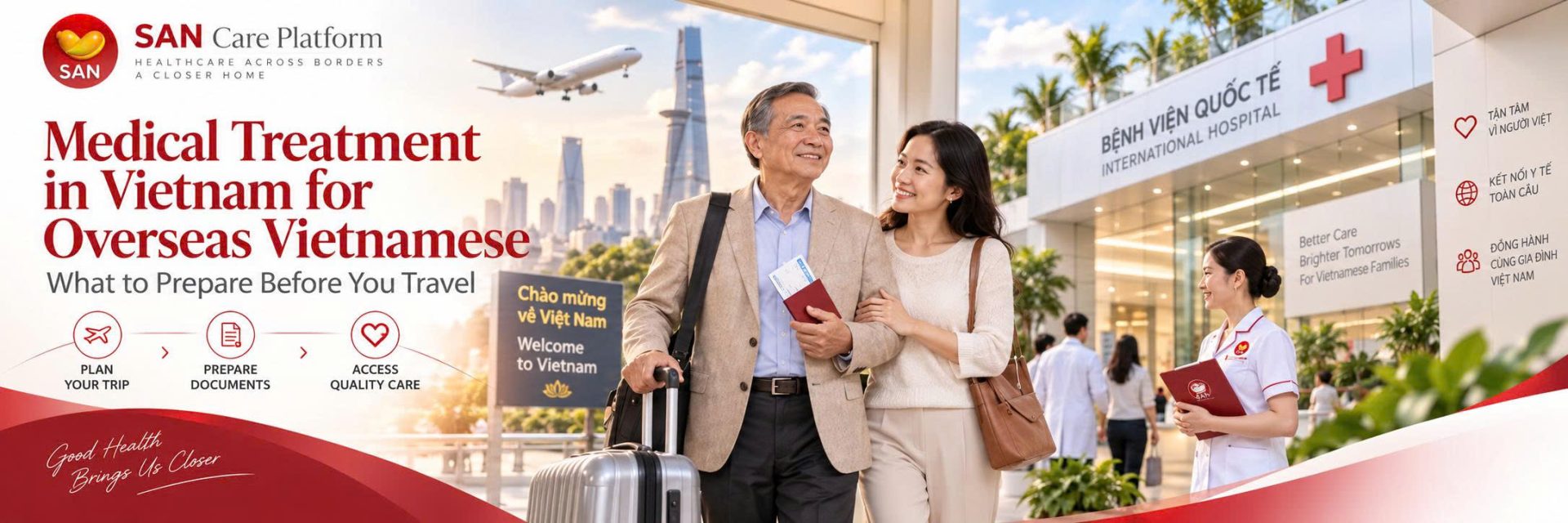
For many overseas Vietnamese, a trip back to Vietnam is more than a family visit.
It may also be an opportunity to schedule a health check-up, follow up on an existing condition, complete diagnostic tests, or continue treatment while spending time with family.
But medical travel requires more planning than simply booking a hospital appointment.
If you are returning from the United States, Canada, Australia, Europe or another country, it helps to think about the entire journey:
Before your flight → arrival in Vietnam → hospital visit → recovery → follow-up → return overseas.
Here are the key things to prepare.
-
Clarify the purpose of your medical treatment visit
Before booking your flight, identify what you actually need to accomplish during your stay in Vietnam.
For example:
- a general health check-up;
- a specialist consultation;
- follow-up for an existing condition;
- diagnostic tests;
- post-treatment follow-up;
- scheduled treatment or surgery;
- recovery after a medical procedure.
Knowing your objective will help determine how many days you should allow and whether you may need assistance during your stay.
For a broader Vietnamese-language guide, see:
[ANCHOR: guide for overseas Vietnamese returning to Vietnam for medical care → /viet-kieu-ve-viet-nam-chua-benh/]
-
Prepare your medical records before travelling
Bring the most relevant documents you already have.
These may include:
- recent medical reports;
- laboratory results;
- imaging reports;
- medication lists;
- prescriptions;
- discharge summaries;
- information about allergies;
- previous treatment records.
Keep digital copies as well as any original documents required for your appointment.
If some records are in English, check with the hospital in advance whether translation is necessary.
For decisions about diagnosis, medication, treatment or whether you are medically fit to travel, always consult a qualified healthcare professional.
SAN caregivers provide non-medical assistance and do not replace doctors, nurses or medical institutions.
-
Avoid planning too much immediately after a long flight
A long-haul flight can be tiring, especially for older adults or anyone travelling while unwell.
Whenever possible, allow some time to:
- settle into your accommodation;
- rest;
- eat and hydrate;
- organize documents;
- reconfirm appointments;
- prepare transportation.
If an elderly family member is travelling, avoid creating an unnecessarily packed medical schedule during the first day.
SAN has an existing guide covering the journey from arrival to the hospital:
[ANCHOR: planning the journey from arrival to the hospital in Vietnam → /ho-tro-viet-kieu-ve-nuoc-kham-benh-tai-benh-vien/]
-
Plan who will accompany you to the hospital
Hospital visits can involve more than meeting a doctor.
Depending on the appointment, you may have to:
- register;
- move between departments;
- wait for tests;
- collect documents;
- complete payment procedures;
- pick up medication;
- return for additional tests.
For an older person, someone with limited mobility or someone unfamiliar with the local hospital environment, having a companion can make the day significantly easier.
A companion can assist with practical matters such as:
- getting ready before the appointment;
- travelling to the hospital;
- carrying documents and personal belongings;
- helping with mobility;
- staying with the patient while waiting;
- assisting with the journey back home.
SAN provides non-medical hospital companion and caregiving support for families who need someone to assist locally.
-
Think about accommodation as part of the healthcare plan
Some overseas Vietnamese stay with relatives.
Others stay in:
- their own home;
- a serviced apartment;
- a hotel;
- accommodation close to the hospital.
Your accommodation matters more if you have several appointments or need time to recover.
Ask:
- Is it easy to enter and exit?
- Is there an elevator if needed?
- Is the bathroom safe for an elderly person?
- How far is it from the hospital?
- Will someone be available to help after the appointment?
Families staying at a private residence can also read:
[ANCHOR: preparing care when recovering at a private home in Vietnam → /ve-viet-nam-chua-benh-o-nha-rieng/]
-
Do not plan only for the hospital appointment
A common mistake is to organize transportation to the hospital but forget what happens afterward.
After a long consultation, test or procedure, the patient may simply need to return home and rest.
Practical assistance may still be needed with:
- meals;
- personal hygiene;
- walking;
- getting in and out of bed safely;
- preparing for the next appointment;
- everyday activities.
If you expect to need support after a short treatment or hospital visit, see:
[ANCHOR: when overseas Vietnamese may need care after an appointment or short treatment → /cham-soc-sau-kham-sau-dieu-tri/]
-
If you already know your travel dates, arrange care in advance
Families do not necessarily need to wait until the patient has arrived in Vietnam.
If you already know:
- arrival date;
- location in Vietnam;
- expected hospital or clinic;
- appointment date;
- type of assistance needed;
you can start discussing care arrangements before travelling.
SAN has a guide specifically for overseas families who want to arrange support before the flight:
[ANCHOR: book Cô SAN before travelling to Vietnam → /dat-co-san-qua-app-hotline/]
-
Understand what a SAN caregiver can and cannot do
Cô SAN focuses on non-medical caregiving and practical assistance.
Depending on the agreed service, support may include:
- assistance with daily activities;
- meals and personal care;
- mobility support;
- accompanying the patient to medical appointments;
- assistance during a hospital stay;
- care at home or accommodation;
- communication with the designated family contact.
Cô SAN does not replace doctors or licensed healthcare professionals.
Diagnosis, prescriptions, medication changes, medical procedures and clinical decisions remain the responsibility of qualified healthcare providers.
-
Prepare for the period before returning overseas
Your healthcare journey does not necessarily end when you leave the hospital.
Before your return flight, check that you have:
- the medical records provided by the hospital;
- prescriptions;
- medication information;
- follow-up instructions;
- your next appointment, if required;
- enough recovery time before travelling.
If you have concerns about whether it is safe to fly after treatment, consult your treating doctor.
Need caregiving support while you are in Vietnam?
SAN can help overseas Vietnamese arrange non-medical caregiving support for different stages of the journey:
At home → going to the hospital → during the hospital stay → after discharge → follow-up visits.
Learn more:
[ANCHOR: SAN caregiving services for overseas Vietnamese → /dich-vu-co-san-cho-viet-kieu/]
Arrange support before you arrive
📲 Download the SAN app to arrange a caregiver based on your needs.
If this is your first time arranging care, or the situation is more complex, contact the hotline first so the SAN team can understand your requirements.

#SAN #SANCarePlatform #SANHomeCare #SANElderlyCare #SANPatientCare #SANHospitalCompanion #CoSAN #SANApp #DownloadSANApp #CaregiverVietnam #MedicalTreatmentVietnam #OverseasVietnamese #VietKieu #VietnamHealthcare #HomeCareVietnam #HospitalCompanionVietnam #ElderlyCareVietnam #PatientCareVietnam


