
Elderly Care for Parents in Vietnam: A Guide for Families Living Overseas
Living abroad can make caring for ageing parents emotionally difficult.
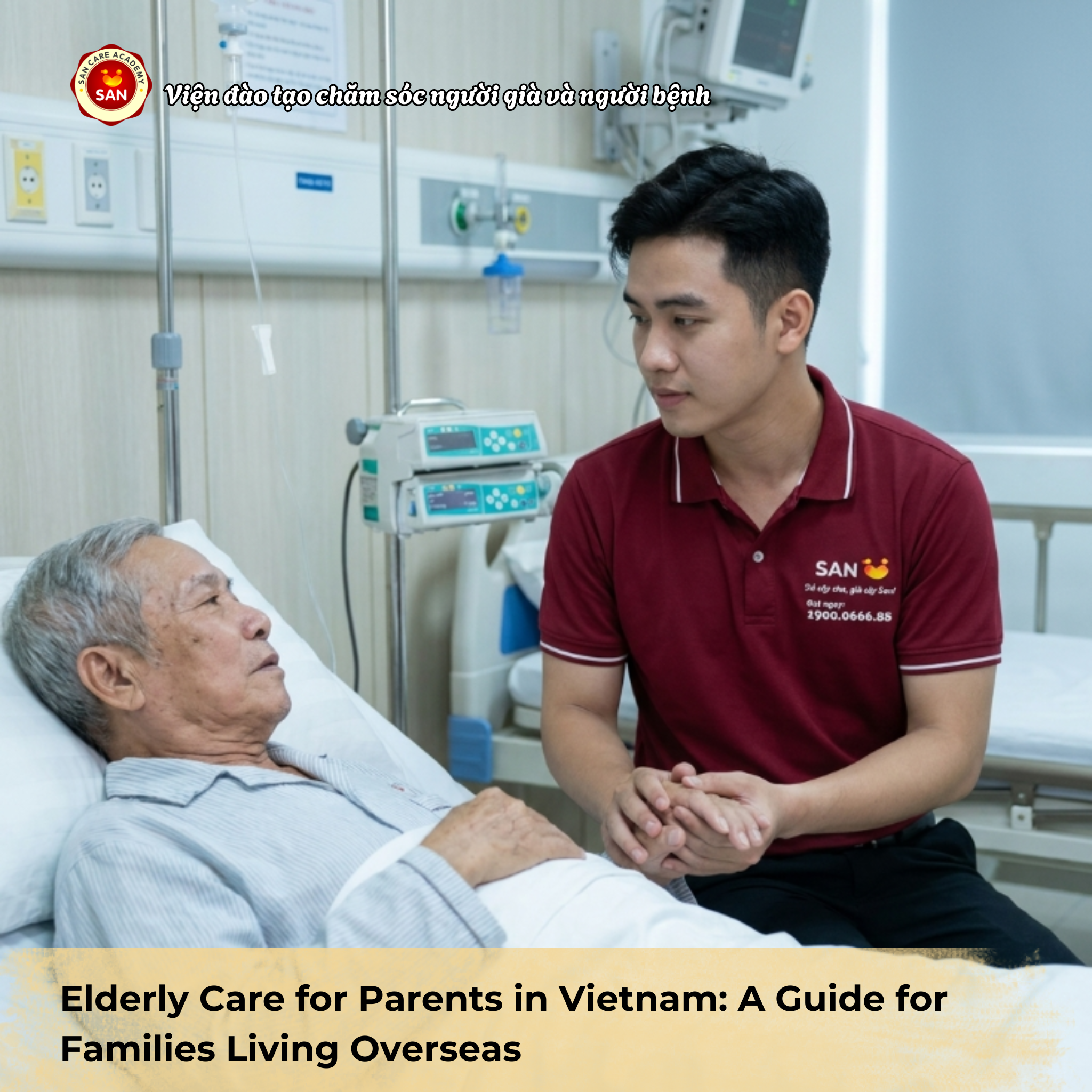
Your parents may still be independent most of the time, but what happens when:
- your mother needs a hospital appointment;
- your father has just been discharged;
- a parent begins walking more slowly;
- they need help for a few hours each day;
- or something changes and you cannot immediately return to Vietnam?
For many overseas Vietnamese families, the real need is not simply “finding a caregiver.”
It is finding reliable local support that allows the family to remain involved even from another country.
1. Start with what your parents can still do independently
Care should not remove independence unnecessarily.
Before arranging support, consider:
- Can your parent prepare meals?
- Can they bathe and dress independently?
- Can they move around the home safely?
- Can they go to medical appointments alone?
- Are they comfortable using transportation?
- Do they spend long periods alone?
- Have there been recent changes in mobility or daily routines?
The goal is to identify where support is genuinely useful.
2. Care does not always have to mean 24-hour support
Some elderly people need continuous assistance.
Many others do not.
A family may only need someone:
- a few hours during the day;
- on specific weekdays;
- after a medical appointment;
- on hospital days;
- during a short recovery period.
Starting with the actual daily need can help families create a more practical care arrangement.
SAN currently provides home and hospital patient-care services with multiple care durations and practical daily-living support.
3. Hospital appointments are often the first time families realize help is needed
A parent may still live independently at home but struggle with a hospital visit.
The challenge may involve:
- transportation;
- walking long distances;
- navigating a large hospital;
- carrying documents;
- waiting for tests;
- returning home afterward.
If children cannot take time off or live overseas, a hospital companion can provide practical support during the journey.
4. After discharge, daily activities may temporarily become more difficult
A parent who has been medically cleared to go home may still need assistance with normal activities.
Depending on the situation, this can include:
- meals;
- personal hygiene;
- walking;
- moving around the home;
- preparing for follow-up visits.
Medical instructions should continue to come from the hospital or healthcare professional.
SAN’s existing post-discharge content specifically positions Cô SAN as non-medical support for daily living, mobility and communication with family members.
5. Remote care needs a communication routine
When children are overseas, simply knowing that “someone is with Mom or Dad” may not be enough.
Families should agree on a simple reporting routine.
For example:
- After each care shift
- Was the parent comfortable?
- Were meals taken normally?
- Was mobility different from usual?
- Was there anything the family should know?
This is not a medical report.
It is a practical update that helps the family understand how the parent’s day went.
SAN’s Vietnamese content already identifies this as a central concern for children living in Australia and Canada who have parents in Vietnam.
6. Time-zone differences should be planned around
If the family is in the United States, Canada, Australia or Europe, communication should not rely on calling randomly throughout the day.
Agree on:
- one primary family contact;
- a preferred communication app;
- a regular update time;
- situations that require immediate contact;
- a secondary contact in Vietnam if available.
A clear process can prevent both the family and the caregiver from becoming confused about who should be informed.
7. Do not turn the caregiver into the family’s medical decision-maker
This boundary is important.
Cô SAN can assist with practical activities and communicate observations.
However, the caregiver should not be expected to:
- diagnose a condition;
- interpret medical results;
- decide whether medication should be changed;
- replace communication between the family and the doctor.
Families should remain directly involved in medical decisions.
8. Caring from overseas is not the same as stepping away
Using a caregiver does not mean children are replacing their role in the family.
A better model is:
- Family overseas
- ↓ remains involved in decisions and communication
- Cô SAN in Vietnam
- ↓ provides practical support
- Parent
- ↓ receives help while maintaining as much independence as possible
That is a very different relationship from simply “hiring someone to stay with an elderly person.”
9. When should you consider more regular support?
A recurring care arrangement may be worth discussing if the parent:
- increasingly struggles with daily activities;
- attends medical appointments frequently;
- lives alone;
- has recently returned home from hospital;
- needs regular companionship;
- or requires more assistance than relatives nearby can consistently provide.
The care schedule can then be reviewed as the situation changes.
10. If your parent is also returning from overseas
Some families have the reverse situation: an elderly parent currently lives abroad and is planning to return to Vietnam temporarily for medical care.
For that journey, see:
If the family wants to arrange support before the flight:
You may live far away. Care for your parents does not have to be far away.
If your parents are in Ho Chi Minh City and need practical support at home, at the hospital or when going to an appointment, SAN can help the family discuss an appropriate care arrangement.
📲 Download the SAN app to request caregiving support.
📞 SAN Hotline: 1900.066.688
SAN – Where compassion is at the heart of every service.
SAN nền tảng chăm sóc


